What Is an Inverter Air Conditioner?
Everything You Need to Know
If you have been shopping for an air conditioner recently, you have almost certainly come across the term inverter air conditioner. Every major brand — from Daikin to Voltas to LG — now prominently advertises its inverter models. But what exactly does “inverter” mean in an AC, and is it really worth the extra cost?
In this comprehensive guide, written by our team of HVAC-certified experts with over 15 years of combined experience reviewing and testing cooling appliances, we break down exactly what an inverter air conditioner is, how the technology works, how it compares to conventional non-inverter models, and everything else you need to make an informed purchase in 2025.
1. What Is an Inverter Air Conditioner?
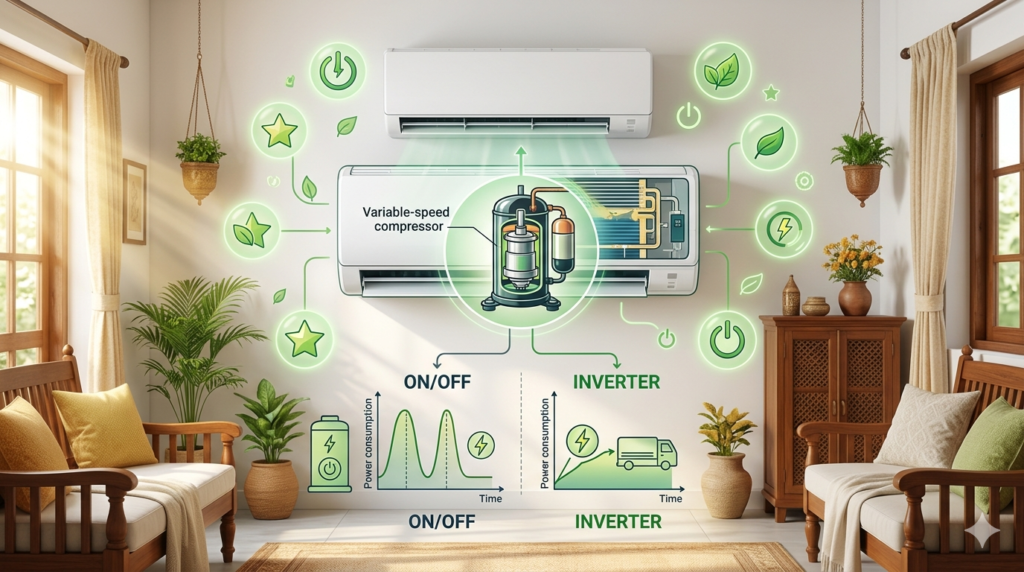
An inverter air conditioner is a type of air conditioning system that uses advanced variable frequency drive (VFD) technology to control the speed of the compressor motor. The word “inverter” here does not refer to a power backup device — it refers to the electronic circuit that converts (inverts) AC power to DC and back again, allowing the compressor motor to run at variable speeds.
In a traditional (non-inverter) AC, the compressor is either fully ON or completely OFF. It runs at full power until the room reaches the set temperature, then shuts down entirely, and restarts when the temperature drifts again. This on-off cycle is energy-intensive and creates noticeable temperature fluctuations.
An inverter AC, by contrast, never fully switches off the compressor. Instead, it throttles the compressor speed up or down based on real-time cooling demand. When the room is very hot, it runs at high speed. Once the target temperature is nearly reached, it slows down to a low maintenance speed — like cruise control in a car.
“Think of an inverter AC like a car engine at cruise control — it uses just enough power to maintain speed, rather than constantly braking and accelerating.”
This seemingly simple change in operating principle has profound effects on energy consumption, comfort levels, noise, and the longevity of the appliance.
2. How Does an Inverter Air Conditioner Work?
Understanding the working principle of an inverter AC helps you appreciate why it performs so much better than conventional models. Here is a step-by-step breakdown:
Step 1 — The Inverter Circuit
The incoming AC power supply (220V, 50Hz in India) is first converted to DC by a rectifier. This DC current is then fed into an inverter circuit — a bank of transistors — which converts it back into AC at a variable frequency and voltage. By changing the frequency of the output, the circuit controls how fast the compressor motor spins.
Step 2 — The Variable-Speed Compressor
Older ACs use a fixed-speed, single-phase induction motor compressor. Inverter ACs use a brushless DC (BLDC) motor or a variable-speed motor that can operate anywhere from around 15 Hz to 120 Hz. At 30 Hz the compressor runs slowly (low cooling output); at 90 Hz it runs fast (maximum cooling output).
Step 3 — Continuous Temperature Sensing & Adjustment
A microprocessor in the indoor unit continuously reads the room temperature via sensors. It computes the difference between the current temperature and the set temperature, then sends a signal to the inverter circuit to increase or decrease compressor speed accordingly. This feedback loop runs dozens of times per second, keeping the room within ±0.5°C of the target temperature.
Step 4 — Stabilised Comfort
Because the compressor is always running at some level (unlike the hard on/off of a conventional AC), the room temperature remains extremely stable. You never experience the uncomfortable warm spike followed by an over-cooling blast that is so common with older ACs.
3. Inverter vs Non-Inverter AC: Key Differences
The table below summarises the most important distinctions between inverter and non-inverter air conditioners to help you compare at a glance:
| Feature | Inverter AC | Non-Inverter AC |
|---|---|---|
| Compressor Operation | Variable speed (continuous) | Fixed speed (on/off) |
| Energy Efficiency | 30–50% more efficient | Higher consumption |
| Temperature Stability | Maintains ±0.5°C | Fluctuates ±2–3°C |
| Noise Level | Very quiet (19–32 dB) | Louder start/stop cycles |
| Upfront Cost | Higher (₹3,000–₹8,000 more) | Lower purchase price |
| Electricity Bills | Significantly lower | Higher running costs |
| Compressor Life | Longer (less wear) | More wear from cycling |
| Works Well in Partial Load | Yes — efficient at all loads | Inefficient at partial load |
| Voltage Fluctuation Tolerance | Better tolerance | Needs stabiliser |
| Best For | Frequent/long daily use | Occasional/short use |
4. Benefits of Inverter Air Conditioners
💚 Lower Electricity Bills
The most compelling benefit of an inverter AC is the reduction in monthly electricity costs. Because the compressor never undergoes repeated start-up surges — which draw 3–5 times the normal running current — and because it scales its power to actual demand, inverter ACs consume far less electricity over the course of a day. A 1.5-ton 5-star inverter AC typically uses 0.7–1.0 units of electricity per hour at steady state, compared to 1.4–1.7 units for an equivalent non-inverter model.
💚 Superior Comfort & Temperature Consistency
With a non-inverter AC, you may notice the room feeling slightly warm just before the compressor kicks back in, followed by a rush of cold air. Inverter ACs eliminate this cycle entirely. The temperature in an inverter-cooled room stays extremely stable, which is particularly appreciated during sleep or in home offices where comfort is paramount.
💚 Quieter Operation
The loud click and vibration of a compressor starting up is entirely absent in an inverter AC. Because the compressor is always running (albeit sometimes very slowly), start-up noise is eliminated. Most inverter models operate at 19–32 dB in quiet mode — about the level of a whisper.
💚 Faster Cooling
When the room temperature is much higher than the set point — such as when you first switch the AC on — the inverter compressor runs at maximum capacity, far exceeding the rated tonnage. A 1.5-ton inverter AC may briefly deliver 2+ tons of cooling power in this phase, bringing the room to the desired temperature significantly faster than a fixed-speed model of the same rating.
💚 Longer Lifespan
Every time an electric motor starts, the windings experience a brief but significant heat and current spike. A non-inverter AC compressor motor may start and stop 8–12 times per hour during normal operation — that is 80–120 times during a 10-hour day. An inverter compressor starts only once per session. This dramatically reduces motor wear, explaining why inverter ACs statistically last 2–3 years longer than their non-inverter counterparts.
💚 Environment-Friendly
Lower energy consumption means a smaller carbon footprint. Many inverter AC models now also use R-32 refrigerant, which has a global warming potential (GWP) of 675 — roughly one-third that of the older R-410A gas. For environmentally conscious buyers, inverter ACs are clearly the better choice.
5. Pros and Cons of Inverter Air Conditioners
✅ Advantages
- 30–50% lower electricity bills
- Precise temperature control
- Quieter during operation
- Faster initial cooling
- Longer compressor lifespan
- Better performance in partial loads
- Good voltage fluctuation tolerance
- More environment-friendly (R-32)
- Higher resale value
❌ Disadvantages
- Higher upfront purchase price
- Complex electronics = costlier repairs
- PCB failure can be expensive to fix
- Break-even may take 2–3 years
- Not ideal for very infrequent use
- Requires AMC for best results
6. Energy Savings & Star Ratings Explained
In India, the Bureau of Energy Efficiency (BEE) rates air conditioners on a 1–5 star scale using a metric called ISEER (Indian Seasonal Energy Efficiency Ratio) for inverter ACs. The higher the star rating, the more efficient the unit is — a 5-star inverter AC is significantly more efficient than a 3-star one.
It is important to note that the BEE uses a separate, higher efficiency benchmark for inverter ACs than for fixed-speed models. So a 3-star inverter AC may already be more efficient than a 5-star non-inverter AC. When comparing models, always check the ISEER value rather than relying solely on the star count.
As a practical example: a 1.5-ton 5-star inverter AC (ISEER ~5.2) running for 8 hours a day over 6 months at ₹8/unit will cost approximately ₹5,760–₹6,200 per season in electricity, compared to ₹9,800–₹11,500 for a non-inverter 3-star model — a saving of ₹4,000–₹5,000 every year.
7. Buying Guide: What to Look For in an Inverter AC (2025)
Capacity (Tonnage)
Choosing the right tonnage is critical. A rule of thumb for Indian conditions: 1 ton per 100–120 sq ft of room area in a standard room with good insulation. For rooms above the ground floor, with west-facing walls or poor insulation, add 20% to the calculated tonnage.
Star Rating
Go for a minimum of 3-star; ideally 5-star if your usage is high. The price difference between a 3-star and 5-star inverter AC is typically ₹4,000–₹7,000 but can be recovered in 1.5–2 seasons through lower bills.
Refrigerant Type
Prefer models using R-32 refrigerant over the older R-410A. R-32 has lower global warming potential, is more efficient, and the refill cost is also lower.
Additional Features Worth Paying For
WiFi connectivity (for app control), PM 2.5 filters, self-cleaning coils, 4-way air distribution, and dual inverter technology (used by LG) are features that add genuine value and are worth considering for a long-term purchase.
Warranty
Look for a minimum 5-year warranty on the compressor (most brands offer 7–10 years) and 1-year comprehensive warranty on the product. Some brands like Blue Star and Voltas offer extended warranty schemes that are worth exploring.
8. Top Inverter AC Brands in India (2025)
| Brand | Known For | Price Range (1.5T 5★) |
|---|---|---|
| Daikin | Reliability, R-32, build quality | ₹45,000–₹65,000 |
| LG | Dual Inverter, smart features | ₹40,000–₹60,000 |
| Voltas | Value for money, after-sales | ₹35,000–₹52,000 |
| Hitachi | Japanese quality, silent ops | ₹44,000–₹62,000 |
| Blue Star | Commercial expertise, durability | ₹38,000–₹56,000 |
| Samsung | WindFree tech, Wi-Fi features | ₹42,000–₹64,000 |
| Carrier | OEM expertise, US brand | ₹36,000–₹54,000 |
9. Frequently Asked Questions (FAQ)
Yes, for most Indian households that run their AC for 6+ hours daily during summer. The energy savings of 30–50% typically recover the higher upfront cost within 2–3 years, after which you save money every subsequent year.
Most modern inverter ACs have built-in voltage stabilisers that handle input ranging from 145V to 265V. An external stabiliser is generally not required, but check your specific model’s specification sheet to confirm the operating voltage range.
A dual inverter AC (a term popularised by LG) uses a twin-rotary compressor with two cylinders instead of one, which reduces vibration, improves efficiency at low speeds, and is claimed to be quieter and more durable. In practice, it offers modestly better efficiency and noise levels compared to single-cylinder inverter compressors.
Inverter ACs have more complex electronics (the PCB/inverter board) that can be expensive to replace — sometimes ₹6,000–₹12,000. However, this is relatively rare. The compressor failure rate is actually lower in inverter models due to reduced mechanical stress. It is advisable to purchase an extended warranty (AMC) for peace of mind.
For rooms up to 110–120 sq ft with reasonable insulation, a 1-ton inverter AC is sufficient and will be more efficient. For rooms between 120–180 sq ft, a 1.5-ton model is appropriate. Over-sizing an AC leads to short cycling and humidity issues even in inverter models.
Conclusion
An inverter air conditioner is one of the smartest home appliance investments you can make in the Indian context, where summers are long, electricity tariffs are rising, and cooling hours are high. By continuously varying its compressor speed to match the exact cooling demand, it delivers more consistent comfort, dramatically lower electricity bills, quieter operation, and a longer service life compared to conventional fixed-speed air conditioners.
The slightly higher upfront cost is a sound investment that pays for itself within 2–3 seasons and continues to deliver savings for the 10–15 year life of the appliance. For anyone using their AC regularly, the question in 2025 is not whether to buy an inverter AC — it is which one to buy.
Leave a Reply