The Strait of Hormuz Toll Trap:
How Iran Turned a Free Waterway Into a Permanent Cash Machine
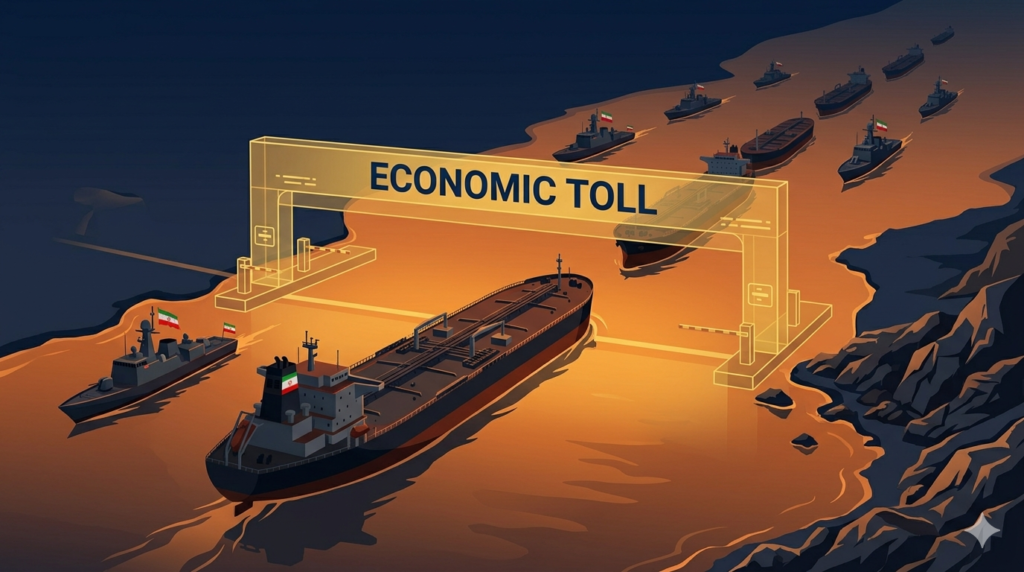
For decades, the Strait of Hormuz was the world’s most important waterway that no country effectively owned. Oil tankers from Saudi Arabia, Kuwait, the UAE, Iraq, and Qatar sailed through it freely — no toll, no fee, no permission slip required. It was, in the truest geopolitical sense, a free corridor for global energy trade. Then came the West Asia war, and everything changed. Iran, sitting right at the mouth of this narrow passage, suddenly realised something extraordinary: it was sitting on the world’s most valuable toll booth — and it had never once charged admission.
Today, that calculation has fundamentally shifted. Iran has leveraged its geographic position along the Strait of Hormuz to assert economic authority over a route that carries nearly 20% of the world’s total oil supply. What began as a military strategy during wartime has quietly evolved into something far more enduring — a long-term income stream that could outlast the war itself by decades.
The Strait of Hormuz is a narrow waterway located between Iran to the north and Oman to the south, connecting the Persian Gulf to the Gulf of Oman and the Arabian Sea. At its narrowest point, it is only 33 kilometres wide — making it the world’s most critical oil transit chokepoint. According to the U.S. Energy Information Administration (EIA), approximately 21 million barrels of oil pass through the strait every single day.
The World Before the War: A Free Highway for Oil Giants
For most of modern history, the Strait of Hormuz operated under a principle known as the right of innocent passage — a concept enshrined in the United Nations Convention on the Law of the Sea (UNCLOS). Under this framework, all ships — military or commercial — had the right to pass through international straits without interference or payment.
Saudi Aramco, Abu Dhabi National Oil Company, Kuwait Petroleum Corporation — the biggest oil exporters in the world — shipped hundreds of millions of barrels through the strait every year. They paid nothing. Not a single dollar to Iran. Not a cent to Oman. The water was treated like a global commons, a shared highway owned by no one and accessible to everyone.
Iran, despite sharing the longest coastline along the strait — approximately 1,500 kilometres of Persian Gulf shoreline — had never formally asserted toll authority over commercial vessels. The international community would have resisted any such move as a violation of maritime law, and Iran lacked the political capital or military confidence to push the issue.
Even during the Iran-Iraq War of the 1980s, when Iranian forces attacked tankers in the so-called “Tanker War,” the goal was disruption — not revenue collection. Iran’s actions were punitive and tactical, not monetised. The concept of a formal Hormuz toll was never seriously proposed until the West Asia conflict changed Iran’s strategic calculus entirely.
How the West Asia War Changed Everything
The outbreak of the wider West Asia war — encompassing the Israel-Hamas conflict, Houthi attacks in the Red Sea, and rising Iran-U.S. tensions — created a new geopolitical reality. Iran, already under severe economic sanctions, found itself in an unusual position: it had enormous military leverage over global oil markets, and for the first time, the world was paying close attention to how it would use it.
The war had an unintended consequence that benefited Iran enormously. As Houthi forces (backed by Iran) began disrupting Red Sea shipping lanes, forcing tankers to reroute around Africa, global attention snapped back to the Strait of Hormuz as the last remaining viable route for Persian Gulf oil exports. Suddenly, the strait wasn’t just strategically important — it was irreplaceable.
Iran’s Realisation: The Toll Booth Moment
Iranian military and political strategists began floating the idea — first quietly, then more assertively — that foreign warships and commercial tankers using the strait owed something to the nations that provided its security infrastructure. Iran’s Islamic Revolutionary Guard Corps (IRGC) navy, which patrols the strait, began conducting more frequent “inspections” of commercial vessels. What looked like security checks began to carry an unmistakable economic subtext.
According to reports covered by Reuters and the Financial Times, several tanker operators reported being asked to coordinate with Iranian maritime authorities before transiting — a process that previously required no such engagement. The bureaucratic friction itself became a form of leverage.
Iran’s legal argument draws on a precedent set by other strategic waterways: the Suez Canal (Egypt), the Panama Canal (Panama), and the Turkish Straits (Turkey, governed by the Montreux Convention) all charge transit fees or impose conditions on passage. Iran has begun framing the Strait of Hormuz as deserving similar status — a managed waterway, not an uncontrolled commons.
The Iran-Oman Axis: Two Nations, One Chokepoint
What makes this geopolitical shift uniquely powerful is the geographic reality: both Iran and Oman share the coastline of the Strait of Hormuz. Any ship entering or exiting the Persian Gulf must pass through waters that are, at minimum, adjacent to — and in many cases within — the Exclusive Economic Zones of these two nations.
Oman, which has historically maintained surprisingly cordial relations with Iran despite being a Sunni-majority monarchy, has quietly aligned on the question of strait governance. Oman has long served as an unofficial back-channel between Iran and Western powers — a role it played prominently during the 2015 nuclear negotiations. This time, Oman’s interest in asserting joint governance of the strait aligns with its own long-term economic ambitions.
What a Formal Toll Structure Could Look Like
While no formal toll mechanism has been officially announced, the framework being discussed in Iranian policy circles involves several potential revenue streams:
- Transit fee per tanker: A flat fee charged per vessel passing through, similar to Suez Canal dues. Even a modest $500,000 per supertanker, applied to the estimated 2,000+ tankers that transit annually, would generate over $1 billion per year.
- Cargo-based levy: A percentage fee based on the declared value or volume of petroleum cargo — similar to how customs duties work in trade.
- Security escort charges: Iran could formalise IRGC naval escorts as a “safety service” and charge for it — a model used informally in piracy-prone waters globally.
- Environmental compliance fees: Framing the levy as an environmental protection measure for Persian Gulf waters — a language that would be harder for Western nations to oppose in international forums.
- Insurance coordination premiums: Requiring tankers to register with Iranian maritime authorities and pay an administrative fee for passage clearance.
| Waterway | Controlling Nation | Annual Revenue | Fee Model |
|---|---|---|---|
| Suez Canal | Egypt | ~$9.4 billion (2023) | Per vessel / cargo value |
| Panama Canal | Panama | ~$4.9 billion (2023) | Per vessel / tonnage |
| Turkish Straits (Bosporus) | Turkey | Regulated (Montreux Conv.) | Light dues + transit fee |
| Strait of Hormuz (proposed) | Iran + Oman | Est. $3–8 billion potential | Transit fee + security levy |
Why This Is Iran’s Biggest Long-Term Strategic Win
Sanctions have crippled Iran’s formal economy for over a decade. The country’s oil exports have been throttled, its banking system cut off from SWIFT, and its currency — the rial — has collapsed in value. Iranian economists have long argued that the country needs revenue sources that cannot be sanctioned away, because they are tied to physical geography rather than financial systems.
A Hormuz toll is precisely that. Geography cannot be sanctioned. The Strait of Hormuz will remain narrow for eternity. Every barrel of Saudi, Kuwaiti, Emirati, and Iraqi oil that flows eastward must pass through it. Unlike oil revenues (which require Iran to actually produce and sell oil under sanctioned conditions), transit fees flow from the activity of others — activity that will continue regardless of Iran’s diplomatic status.
Geopolitical analysts at institutions like Chatham House have noted that Iran’s long-term leverage lies not in its oil reserves but in its location. “Iran is essentially a toll-collecting geography waiting to be monetised,” one analyst noted. The war has provided the political cover to begin that monetisation without appearing to violate international norms unilaterally.
What This Means for India — And Why Indians Should Pay Close Attention
India imports approximately 85% of its crude oil, and a significant portion of that — including supplies from Saudi Arabia, the UAE, Iraq, and Kuwait — transits through the Strait of Hormuz. Any toll, fee, or friction added to this route directly affects what Indian refineries pay for crude, which eventually flows through to petrol and diesel prices at the pump.
India’s Ministry of Petroleum and the Petroleum Planning & Analysis Cell (PPAC) monitor Hormuz developments closely. A 10% increase in tanker transit costs could translate into a noticeable bump in India’s import bill — already strained by a weak rupee and high global energy prices.
Ironically, India has quietly been building closer economic ties with Iran through mechanisms like the Chabahar Port agreement — a strategic bet that, if Iran does gain formal transit authority over the Hormuz, India’s bilateral relationship with Tehran becomes economically critical rather than merely diplomatic.
Common Mistakes in Understanding This Situation
- Assuming it violates international law: Iran’s legal team is studying the Suez and Panama precedents carefully. A formalised, non-discriminatory toll applied equally to all nations would likely survive international legal challenges.
- Thinking the war must end first: Iran doesn’t need peace to assert transit authority — it needs sustained leverage. The wartime environment actually makes it easier, not harder.
- Believing the U.S. can stop it: The U.S. Fifth Fleet patrols the Gulf, but boarding and blocking commercial vessels that comply with Iranian transit fees would put the U.S. in the position of disrupting global oil markets — something no American administration will risk.
- Ignoring Oman’s role: Oman’s silent alignment gives the toll concept bilateral legitimacy. It becomes a joint policy of two sovereign nations, not a unilateral Iranian imposition.
- Treating it as temporary: Once established, transit fees on strategic waterways are never removed. The Suez Canal has been charging since 1869. Panama since 1914. Hormuz, once monetised, will likely charge forever.
The Post-War Horizon: A Revenue Stream Built to Last
Here is the most remarkable aspect of this shift: even when the West Asia war eventually ends — through diplomacy, exhaustion, or a negotiated settlement — Iran’s geographic position will remain unchanged. The Strait of Hormuz will still be 33 kilometres wide. Iranian coastline will still flank its northern shore. The IRGC will still patrol its waters.
What the war has done is provide the political legitimacy and the precedent for Iran to assert authority that it was always entitled to by geography but never felt empowered to claim. Wars change norms. After World War I, the Montreux Convention gave Turkey sovereign control over the Bosporus. After the Suez Crisis of 1956, Egypt permanently controlled the Suez Canal. The West Asia conflict is creating the conditions for a similar lasting settlement of Hormuz governance — and Iran is positioning itself to be the primary beneficiary.
Estimates from energy economists suggest that a formalised Hormuz toll — even at modest rates — could generate between $3 billion and $8 billion annually for Iran and Oman combined. For a country whose total GDP hovers around $400 billion under sanctions, this is not marginal income. It is transformative.
If Iran formalises Hormuz transit fees, expect three immediate market effects: (1) a structural increase in tanker day-rates globally; (2) accelerated investment in alternative pipeline routes like the Abu Dhabi Crude Oil Pipeline (ADCOP) and Saudi Arabia’s East-West Pipeline; and (3) higher long-run oil price floors, as the cost of every Persian Gulf barrel rises by the toll amount. Investors in shipping stocks, pipeline infrastructure, and crude oil futures should monitor Iranian maritime policy announcements closely.
Conclusion: Geography Is the Oldest Form of Power
The story of the Strait of Hormuz and the West Asia war is ultimately a story about how geography — unchangeable, unchallengeable, eternal — is the most durable form of national power. Iran spent decades being punished for its politics, its ideology, and its nuclear ambitions. But through all of it, its geography remained untouchable.
A waterway that was once free for all has become a lever of extraordinary economic potential. The war didn’t create this leverage — it simply revealed it. And once a nation realises the value of what it already holds, it rarely surrenders that advantage voluntarily.
For India, for global oil markets, and for every nation whose energy security depends on Persian Gulf crude flowing freely eastward, the monetisation of the Strait of Hormuz is not a hypothetical future risk. It is an unfolding geopolitical reality — and the world would do well to start pricing it in.
Frequently Asked Questions
Leave a Reply