Gudi Padwa & Ugadi
— India’s Festival of New Beginnings
The spiritual, cultural, and culinary celebration that marks the dawn of a new Hindu year across Maharashtra, Karnataka, Andhra Pradesh, Telangana, and beyond.
Every spring, as the earth warms and flowers bloom, millions of Hindus across India wake before dawn, bathe in fragrant water, and step into a world adorned with mango leaves, marigold garlands, and the scent of fresh neem. This is Gudi Padwa and Ugadi — the Hindu New Year — a festival that is at once ancient and alive, steeped in mythology yet vibrantly celebrated today. Observed on the first day of the Hindu lunar month of Chaitra, these two names describe the same cosmic event, each carrying the unique cultural fingerprint of the region that celebrates it.
This guide dives deep into the significance of Gudi Padwa and Ugadi, the stories behind them, how different Indian states mark the occasion, and — crucially — the extraordinary regional foods that make this celebration a feast for every sense.
What Are Gudi Padwa and Ugadi? Understanding the Hindu New Year
Gudi Padwa is the Marathi name for the Hindu New Year, celebrated predominantly in Maharashtra and parts of Goa and Konkan. Ugadi (also spelled Yugadi) is the same festival observed in Karnataka, Andhra Pradesh, and Telangana. The word Ugadi is derived from the Sanskrit words Yuga (era or age) and Aadi (beginning) — literally meaning “the beginning of an era.”
Both fall on Pratipada Tithi (the first lunar day) of the bright fortnight (Shukla Paksha) in the month of Chaitra, which typically lands in March or April according to the Gregorian calendar. In 2025, Gudi Padwa and Ugadi fall on 30th March.
These festivals are not merely calendar markers. They represent a philosophical and spiritual reset — a time to close accounts (both literal and metaphorical), reflect on the past year, seek blessings for the one ahead, and revel in the beauty of new beginnings. Ancient Hindu almanacs (Panchangas) are traditionally read on this day, outlining the astrological character of the year to come.
Did You Know? According to Hindu mythology, Lord Brahma — the creator of the universe — began the act of creation on the day of Ugadi/Gudi Padwa. It is also believed that Lord Rama returned to Ayodhya and was crowned king on this auspicious day, making it a confluence of cosmological and historical significance.
The Mythological & Historical Significance of Gudi Padwa and Ugadi
The roots of this festival run deep into the soil of Hindu cosmology and epic history. Multiple sacred narratives converge on this single day, giving it layered meaning across communities.
The Brahma Connection
The Brahma Purana, one of the eighteen major Puranas, explicitly states that Lord Brahma created the universe on the first day of the month of Chaitra. This makes Ugadi/Gudi Padwa literally the “birthday” of creation — a day when the cosmic clock began ticking. For devout Hindus, celebrating this day is an act of alignment with the divine order of time itself.
Shalivahana and the Gudi Flag
A particularly beloved Maharashtrian legend connects Gudi Padwa to the legendary King Shalivahana of the Satavahana dynasty. According to oral tradition, after a great victory over the Sakas (Scythian invaders), Shalivahana’s people hoisted gudis (ceremonial bamboo staffs) outside their homes in celebration. The Shaka calendar, which Shalivahana is credited with instituting, begins on this very day — making Gudi Padwa both a lunar and a historical new year.
Rama’s Return and Coronation
Several Hindu traditions hold that Lord Rama returned to Ayodhya from Lanka after defeating Ravana on Chaitra Pratipada. His subsequent coronation — the Ram Rajyabhisheka — is said to have occurred on this day, infusing it with the energy of dharmic triumph. Hoisting a Gudi is thus also a symbolic celebration of the victory of righteousness over evil.
The Ugadi Panchanga Shravana
In Karnataka and Andhra Pradesh, a ritual of great social importance takes place on Ugadi: the public reading of the Panchanga (the Hindu almanac). Priests or learned scholars gather communities to listen to predictions about rainfall, harvests, political events, and general fortune for the coming year. This ritual — Panchanga Shravana — is an act of collective listening, a way of entering the new year with awareness and preparedness.
The Gudi: Symbol, Setup, and Spiritual Power
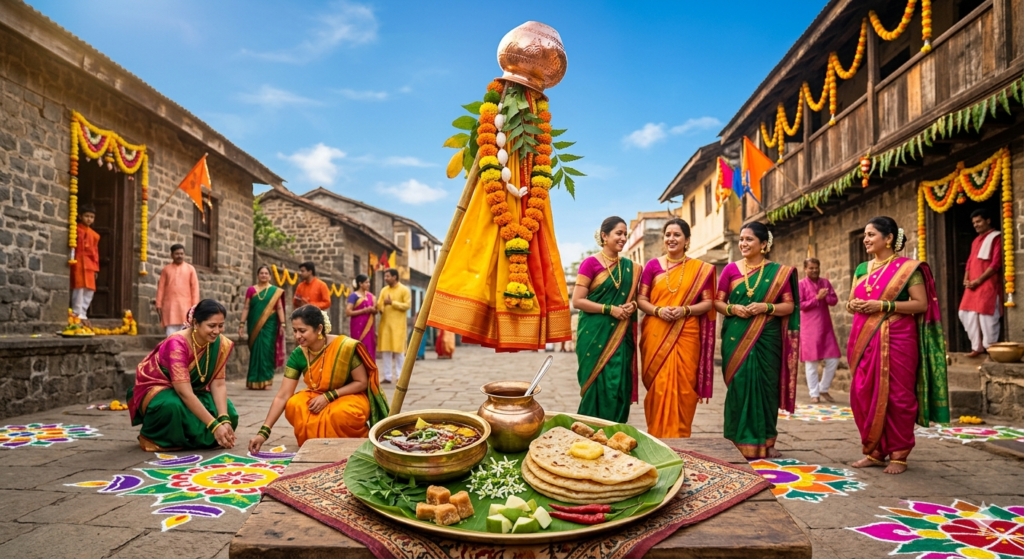
The visual centerpiece of Gudi Padwa is, of course, the Gudi itself. A tall bamboo staff is draped with a bright silk cloth — traditionally green, yellow, or red — and adorned with a garland of marigolds, mango leaves, and neem twigs. A copper or silver pot (kalash) or an inverted bronze vessel (tambe) is placed atop, sometimes decorated with a swastika symbol.
The completed Gudi is hoisted outside the front door or on a window facing the street, high enough to be seen by passersby. It is a declaration: prosperity and victory dwell here. It is said that a Gudi wards off evil spirits, invites Brahma’s blessings, and symbolizes the victory of good over evil.
Before hoisting, the Gudi is worshipped with water, kumkum (vermillion), turmeric, and flowers. Families gather in their finest traditional clothes for this morning ritual. In Mumbai and Pune, entire streets come alive with competing Gudis, creating a festive skyline of colour and spirit.
How Gudi Padwa and Ugadi Are Celebrated Across India
Though the spiritual core is shared, the way this festival is celebrated varies delightfully across India’s regions. Each state brings its own language, customs, aesthetics, and flavours to the table.
The Gudi is hoisted at the crack of dawn. Streets are swept, decorated with rangoli, and strung with torans of mango leaves. Families dress in traditional nauvari saris and dhoti-kurtas. Cultural processions with folk dances, lezim performances, and traditional music fill city streets.
Homes are cleaned and decorated with torana of mango leaves. Families wake early, perform oil-bath rituals, and wear new clothes. The Panchanga is read aloud. Temples overflow with devotees. The highlight is the communal preparation and sharing of Bevu Bella — a mix of neem flowers and jaggery.
Similar to Karnataka, with a strong emphasis on the Panchanga Shravana at temples. Home decorations include intricate muggulu (rangoli). New clothes are mandatory, and visits to elders for blessings are an important ritual. The Ugadi Pachadi is the culinary centrepiece.
Known as Samvatsar Padvo, it is celebrated much like in Maharashtra. Fishing communities and farmers particularly celebrate this day as an auspicious marker for beginning new ventures. Goan Hindus adorn the Gudi with bright silk and flowers typical of the coastal tropics.
In Rajasthan, the same lunar day marks Navratri beginning. Kashmiri Pandits celebrate Navreh, placing a tray of seasonal items near the sleeping person to be the first thing seen in the new year. Northern states also consider this the start of the Vikram Samvat Hindu calendar year.
Sindhis celebrate Cheti Chand on the same day, marking the birth of Jhulelal (their patron deity). Tamil Nadu celebrates Vishu (in April) as their new year. These parallel celebrations underscore how the spring new year resonates across nearly every Hindu community in India.
The Sacred Foods of Gudi Padwa and Ugadi: A Regional Feast
No Hindu festival is complete without its ritual foods, and Gudi Padwa/Ugadi is exceptional in this regard. Each region prepares specific dishes that carry deep symbolic meaning — foods that represent the six flavours of life itself.
Ugadi Pachadi — The Quintessential Ugadi Dish
If there is one dish that defines the essence of Ugadi, it is Ugadi Pachadi — a raw chutney made from six distinct ingredients, each representing a different taste and, by extension, a different emotion or experience in life.
| Ingredient | Taste | Symbolism |
|---|---|---|
| Neem flowers (Bevu) | Bitter | Sorrow, hardship, and difficult times |
| Jaggery (Bella) | Sweet | Joy, happiness, and sweet moments |
| Raw mango pieces | Sour / Tangy | Surprise and unexpected events |
| Tamarind | Tart | Disgust and unpleasant experiences |
| Green chillies | Spicy / Hot | Anger and fiery situations |
| Salt / Tender coconut | Salty / Mild | Fear and anxiety |
Eating Ugadi Pachadi is a deeply philosophical act. By consuming all six tastes together, one acknowledges and accepts that life is a blend of all experiences — and commits to facing each with equanimity. No taste (no experience) is discarded. All are welcomed.
Bevu Bella — Karnataka’s Neem and Jaggery Ritual
In Karnataka, the festival begins with Bevu Bella — a simple mixture of neem flowers and jaggery that is distributed to every family member and even to neighbours. This practice predates written records and is accompanied by a traditional verse: “The consumption of neem flowers representing sorrow and jaggery representing happiness means that in all of life’s changes — pleasant and unpleasant — we remain balanced.” No Ugadi in Karnataka is complete without this ritual, which is performed first thing in the morning, even before breakfast.
Maharashtra’s Gudi Padwa Foods
Maharashtrian homes on Gudi Padwa burst with the aromas of a very specific menu:
- Puran Poli: The crown jewel of Gudi Padwa cooking. These sweet, flatbread-like rotis are stuffed with a filling of cooked chana dal, jaggery, cardamom, and nutmeg. Every family has a slightly different recipe, passed down through generations. The sweetness of Puran Poli symbolises the sweetness of the new year.
- Shrikhand: A luscious, saffron-tinged strained yogurt sweetened with sugar and cardamom, eaten with puri. The combination of Shrikhand-Puri is so beloved it is almost synonymous with Gudi Padwa.
- Aambyachi Dal (Raw Mango Dal): A tangy, delightful dal made with raw green mangoes, toor dal, and spices. The sour punch of raw mango makes this a seasonal specialty available only at this time of year.
- Batata Bhat (Potato Rice): A simple, fragrant rice dish cooked with potatoes, mustard seeds, turmeric, and cashews — a savoury counterpart to the sweet dishes of the day.
- Neem Chutney: Just like Karnataka, Maharashtra also has the tradition of eating a small portion of neem leaves (often ground into a chutney with jaggery) on this day to accept life’s bitter moments.
- Kanangachi Kheer: A fragrant pudding made from sweet potatoes (kanang) cooked in coconut milk — a Konkani speciality eaten in coastal Maharashtra and Goa.
Andhra Pradesh and Telangana’s Ugadi Feast
Beyond the universal Ugadi Pachadi, Telugu households prepare a grand celebratory meal:
- Ugadi Pachadi: As described above — the cornerstone of the day.
- Bobbatlu / Obbattu (Bhakshalu): Called Bobbattu in Telugu and Obbattu in Kannada, these are sweet flatbreads filled with a mixture of chana dal and jaggery — similar to Puran Poli but with their own unique spice profile and texture. The dough is often made with maida (refined flour) and must be rolled paper-thin.
- Pulihora (Tamarind Rice): A tangy, spiced rice dish cooked with tamarind paste, mustard seeds, dry red chillies, curry leaves, and peanuts. Pulihora is considered auspicious and is distributed as prasad in temples across Andhra Pradesh on Ugadi.
- Pesarattu: Green moong dal crepes, often eaten as a festive breakfast with ginger chutney. Light, nutritious, and utterly delicious, they represent the freshness of the new year.
- Mango Dal (Mamidikaya Pappu): Raw, sour green mangoes cooked with toor dal and tempered with ghee, mustard seeds, dry red chillies, and hing. The tartness of the mango is the soul of this dish.
- Chalimidi: A special sweet made from rice flour, jaggery, and coconut — traditionally offered as naivedyam (food offering to God) on Ugadi.
Karnataka’s Ugadi Special Menu
- Obbattu / Holige: Karnataka’s version of the sweet stuffed flatbread, considered the festival’s signature sweet. Filled with a paste of cooked chana dal, jaggery, and coconut, and served piping hot with generous ghee and Paanaka (a sweet cardamom drink).
- Mango Chitranna (Maavinakayi Chitranna): Raw mango rice — a tangy, fresh rice preparation that celebrates the season’s first mangoes, tempered with coconut, curry leaves, and peanuts.
- Kosambari: A refreshing raw salad made with soaked moong dal, cucumber, grated coconut, and lemon juice. Light, bright, and auspiciously green, it is a ritual first course in many Karnataka homes.
- Paanaka: A sacred drink made with jaggery, water, cardamom, dry ginger, and black pepper. It is offered to deities and consumed by devotees, especially in Rama temple celebrations on this day.
- Majjige Huli: A light, yogurt-based curry with vegetables, tempered with coconut paste and mild spices — a staple of Karnataka’s festive thali.
Goa and Konkan’s Unique Contributions
- Patholi: Steamed rice dumplings made from rice flour mixed with coconut and jaggery, wrapped in turmeric leaves. The fragrance of the turmeric leaf infuses the dumpling, giving it an unmistakably festive aroma.
- Modak: Steamed rice flour dumplings filled with coconut and jaggery — beloved in Goa and Konkan for auspicious occasions.
- Solkadhi: While not exclusive to Gudi Padwa, this cooling coconut milk and kokum drink is a festive staple in coastal homes — its pink colour and tangy-sweet flavour making it distinctly celebratory.
The Spiritual Rituals and Customs of the Day
Beyond the kitchen and the streets, Gudi Padwa and Ugadi are days of deep personal and family ritual. The observances begin before sunrise and continue throughout the day:
- Oil Bath (Abhyanga Snan): Before any celebrations, family members bathe with sesame oil, which is considered purifying and auspicious. This ritual is followed in Maharashtra, Karnataka, and Andhra Pradesh alike.
- New Clothes: Wearing new clothes on Ugadi/Gudi Padwa is considered mandatory — it symbolises stepping into the new year fresh and unburdened by the past.
- Deity Worship: Prayers are offered to Lord Brahma (creator), Lord Vishnu, and the family’s Kuldevi (ancestral deity). Temples are thronged with devotees from dawn onward.
- Panchanga Shravanam: Particularly in Karnataka and Andhra Pradesh, listening to the year’s astrological predictions from a learned priest is an important ritual.
- Gifting and Sharing: Sweets and cooked food are shared with neighbours, distributed to the less fortunate, and gifted to family members. The spirit of abundance and generosity is central to the day.
Why Gudi Padwa and Ugadi Matter in Modern India
In an era of rapid globalisation, Gudi Padwa and Ugadi remain deeply relevant. They are cultural anchors — days that pull families back to their roots, reconnect urban youth with ancestral traditions, and remind everyone of the values embedded in Hindu thought: acceptance of life’s full spectrum, gratitude for creation, the cyclical nature of time, and the importance of community.
The rituals also carry significant wellness wisdom. Neem, consumed on Ugadi, is a powerful antioxidant and antibacterial agent. The raw mango, tamarind, and jaggery in Ugadi Pachadi are rich in vitamins, minerals, and digestive aids. The shift from winter to spring that coincides with this festival is precisely when Ayurveda recommends dietary adjustments — and the traditional Ugadi/Gudi Padwa menu follows this guidance naturally.
In cities like Mumbai, Pune, Bengaluru, and Hyderabad, Gudi Padwa and Ugadi have also become occasions for large cultural processions, street fairs, food festivals, and community gatherings that bring together people of all backgrounds. The festival’s visual language — bright colours, floral decorations, folk music — has an infectious joy that transcends religious boundaries.
Frequently Asked Questions About Gudi Padwa and Ugadi
They are essentially the same festival — the Hindu New Year on the first day of Chaitra. “Gudi Padwa” is the Marathi name used in Maharashtra and Goa, while “Ugadi” or “Yugadi” is the Kannada/Telugu name used in Karnataka, Andhra Pradesh, and Telangana. The date, lunar timing, and spiritual significance are identical, but regional customs, foods, and rituals differ.
Ugadi Pachadi is a raw chutney made of six ingredients — neem flowers (bitter), jaggery (sweet), raw mango (sour), tamarind (tart), green chilli (spicy), and salt (salty). Each taste represents a different life experience. Eating it is a philosophical acceptance that life contains all flavours, and one must embrace them all.
In 2025, Gudi Padwa and Ugadi fall on 30th March. The Pratipada Tithi (first day of the bright fortnight of Chaitra) begins on the evening of 29th March and continues through 30th March, making 30th March the main day of celebration.
The Gudi — a bamboo staff decorated with silk cloth, marigolds, mango/neem leaves, and an inverted pot — symbolises victory, prosperity, and the warding off of evil. It commemorates King Shalivahana’s victory over the Sakas and Lord Rama’s return to Ayodhya. A Gudi is a public declaration of auspiciousness and well-being.
The primary states are Maharashtra (Gudi Padwa), Goa (Samvatsar Padvo), Karnataka (Yugadi), Andhra Pradesh (Ugadi), and Telangana (Ugadi). Sindhi communities across India celebrate Cheti Chand on the same day, and Kashmiri Pandits celebrate Navreh. Many Hindu communities across North India also observe this day as the start of the new Vikram Samvat year.
A New Year Rooted in Wisdom
Gudi Padwa and Ugadi are among India’s most thoughtfully designed festivals. They ask us to accept all of life — bitter and sweet, sour and spicy — with an open heart. They anchor us in the rhythms of the earth, the wisdom of the Vedas, and the warmth of community. Whether you are hoisting a Gudi in a Mumbai lane, sharing Bevu Bella in a Bengaluru home, or tasting Ugadi Pachadi in Hyderabad, you are participating in a tradition that is thousands of years old and as fresh as a mango from the season’s first harvest.
Ugadi Shubhashayagalu! Gudi Padwachya Hardik Shubhechha!
Wishing you a new year filled with all six flavours of life — beautifully balanced.
Leave a Reply