The Great Indian LPG Revelation:
When Gen Z Discovered That Food Doesn’t
Come From The Cloud
A nation of Zomato loyalists confronts a terrifying truth — cooking involves gas, gas involves a cylinder, and a cylinder apparently does not accept UPI payments.
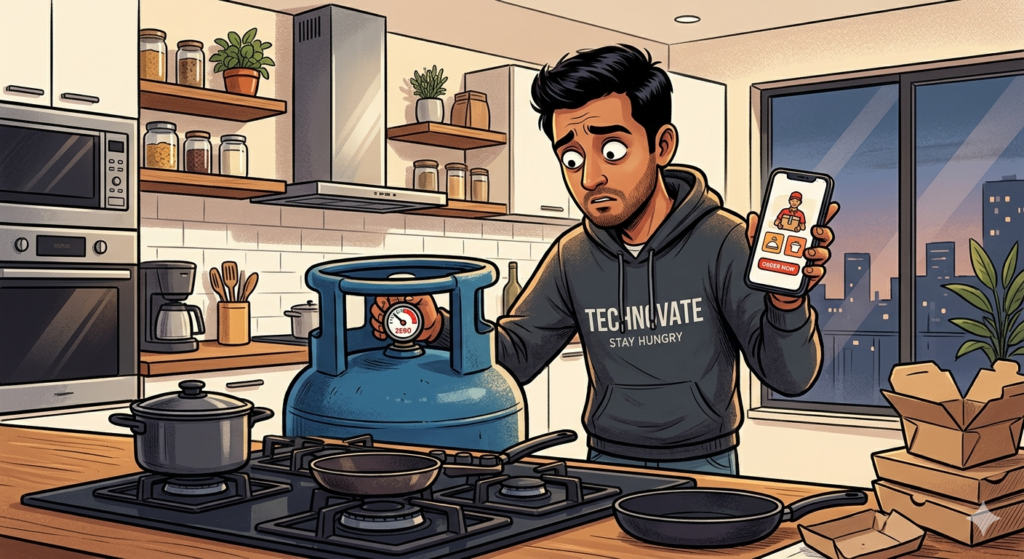
It began, as most civilisational crises do, on a Tuesday morning. Across India’s gleaming IT corridors — from Whitefield to Hitech City, from Powai to Sector 62, Noida — a generation of otherwise highly skilled professionals found themselves staring into an abyss they had never before contemplated: a kitchen. Not as a backdrop for an Instagram Reel. Not as a place to store oat milk. An actual, functioning kitchen — in which the gas stove clicked twice, wheezed, and then delivered the most existentially disturbing sound a 26-year-old software engineer can hear.
Silence.
The LPG cylinder was empty. The Swiggy app was down for maintenance. And for the first time in perhaps their entire adult lives, an entire urban cohort had to confront a question that their parents had never thought to ask, because the answer seemed so self-evident: Where does food come from?
NDTV Urban: “City Millennials Stage Silent Protest Outside Dark Stoves” — Demand Zomato Deliver LPG Gas Cylinders
- Bengaluru techie opens kitchen cabinet for first time; finds 2019 Maggi packet and profound sense of failure.
- Mumbai 28-year-old asks flatmate, “Is ‘cooking’ something you do with the microwave or the induction?” Flat descends into civil war.
- Hyderabad startup founder pivots company to “HyperLocal Gas Delivery” within 40 minutes of the shortage. Valuation: ₹0.
- Pan-India Google searches for “how to boil water” spike 4,700% overnight. “How to boil water without gas” surges to #1 trending.
- Zomato stock temporarily drops as users angrily leave 1-star reviews blaming app for the gas shortage.
🧠 The Epistemological Crisis at Flat No. 304
Rahul, a 27-year-old senior associate at a fintech firm in Gurugram, had not thought about LPG since approximately 2019, when he moved out of his parents’ house and discovered that Swiggy offered 30-minute delivery on biryani. In his mind, the food supply chain was elegantly simple: open app → tap dish → pay → eat. He had vaguely understood that somewhere in the process, a “cloud kitchen” was involved. What happened inside the cloud kitchen was, frankly, not his problem.
Until last Tuesday.
Rahul, 7:02 AM: “Okay, I will make the egg myself. I am a competent adult.”
Rahul, 7:04 AM: “The gas is not working.”
Rahul, 7:05 AM: “What is a gas booking? What is an HP number? What is a regulator? Why is there a knob on the cylinder? Why does it say ‘Net Wt. 14.2 kg’? Why is it empty? When did it get empty? When was it last full? WHO IS RESPONSIBLE FOR THIS?”
Rahul’s story is not unique. It is the story of an entire generation — brilliant, capable, digitally sovereign — who had simply never been given the opportunity to discover that food is cooked using fire, fire requires gas, and gas is delivered by a man on a bicycle who calls you on a number you’ve never saved.
📱 Stage Two: The Bargaining Phase (With An App)
The natural first response to any problem, for this demographic, is to find an app for it. Priya, a product manager in Bengaluru’s Koramangala, spent 45 minutes searching for a hyperlocal gas delivery app before accepting — with the hollow look of someone who has just learned Santa Claus is fictional — that no such app had yet disrupted this particular market.
She then attempted to order a gas cylinder on Blinkit. Blinkit, to its credit, did list “Gas Lighter (piezo, stainless steel, pack of 2)” — which Priya added to cart, slightly hopefully, before realising that a lighter requires something to ignite.
She then texted her mother. Her mother, a woman who had managed a family of four across three cities on a single LPG connection, replied in 0.4 seconds with the HP Gas booking number, the IVR menu sequence, the expected delivery timeline, the name of the delivery person who had been their agent for nine years, and a gentle reminder that she had told Priya to save this number “in 2021 itself.”
Priya stared at her phone screen for a long moment. Then she typed: “Thanks, Amma 🙏”. Then, after a pause: “How do you know all this?”
Her mother did not reply. Some knowledge, it seems, is passed down not through apps but through decades of just quietly making sure nobody went hungry.
🔬 A Brief Anthropological Study: What Lives In Their Kitchens
An informal survey of ten urban apartments in the 25–32 age bracket, conducted during the shortage, revealed the following contents of their kitchens:
- Three varieties of protein powder (none of which can be cooked)
- A Nutribullet blender, still in the box, gifted by parents “for smoothies”
- A collection of Zomato-branded tote bags that have become the primary kitchen décor
- Assorted sauces: sriracha, truffle mayo, Korean gochujang — all purchased enthusiastically after a cooking phase that lasted one weekend in 2022
- Half a packet of dal that predates the current tenancy
- One functioning microwave, used exclusively for reheating deliveries
- A cooking pan with a factory-fresh, unseasoned appearance
- An LPG cylinder that is — as we have established — empty
The one item conspicuously absent from every kitchen: the HP/Indane/Bharat Gas customer care number. This, it turns out, is the single most important piece of kitchen equipment, and it lives exclusively in mothers’ phones.
Before (The Golden Age)
- Food appears in 28 minutes
- Kitchen is a storage unit
- “What’s for dinner?” = Open Zomato
- Gas cylinder is a decorative object
- Cooking is a “fun activity” for Sundays
- Parents’ advice filed under “boomer concern”
- Induction cooker is a “good backup someday”
After (The Enlightenment)
- Food requires a 3–5 day cylinder wait
- Kitchen is a source of existential dread
- “What’s for dinner?” = boiled eggs, if lucky
- Gas cylinder is a precious, finite resource
- Cooking is a desperate survival skill
- Parents’ advice is immediately screenshot-saved
- Induction cooker is panic-ordered on Amazon Prime
🧑🍳 The Magnificent Five: Those Who Actually Knew How To Cook
In every apartment building, during the shortage, a certain individual quietly emerged as a figure of near-mythological status: the person who knew how to cook. This person — typically someone from a tier-2 city, or someone who had done their undergrad in a hostel without a canteen, or simply someone whose mother had been more insistent — was suddenly the most popular person in the building.
Arjun, a backend developer from Nagpur living in a four-person flat in Pune’s Kothrud, had booked a refill two weeks in advance — a habit instilled by his father with the same quiet firmness that his father had instilled the ability to drive, to budget, and to eat without spending ₹800 a day on delivery fees. During the shortage, Arjun cooked dal-rice on his working cylinder for all four flatmates on Day 1.
By Day 3, he had been given the title of “Bhaiya” by three people who were, technically, older than him. One flatmate offered to pay his EMI. Another asked if he would be interested in a “co-founder role” in their startup. A third simply sat in the kitchen watching him cook with the wide-eyed reverence of someone witnessing a TED Talk.
🌅 The Aftermath: A New Dawn, Or At Least A Functioning Burner
The cylinders eventually arrived. Deliverymen — those unsung heroes who have carried 14.2 kilogrammes of civilisation up six flights of stairs without a lift, twice a month, for decades — were greeted at doors by 27-year-olds in startup hoodies who suddenly understood, with the full force of revelation, what it means to be truly essential.
Several people tipped generously. One person offered chai, forgetting momentarily that the old cylinder was what had made chai impossible in the first place. Another person filmed the cylinder installation for Instagram Stories with the caption “the most underrated ASMR.” It received 400 views and seven comments saying “relatable rn 😭”.
The culinary ambitions of the first post-shortage weekend were, admittedly, short-lived. Most people cooked exactly once — a brave, photogenic attempt at pasta or khichdi — posted it to their Stories with “domestic era incoming 🍳✨”, received the required affirmation, and then, on Sunday evening, returned quietly to Swiggy with the relief of a prodigal child returning home.
But something had shifted. Somewhere in the back of everyone’s mind — behind the Notion workspace and the Spotify playlist and the carefully maintained hot-take about React versus Angular — a small, new file had been created and saved. It contained one phone number. The HP Gas booking number. And the knowledge, finally and permanently, that fire does not come from the cloud.
🎓 The Moral of The Story (For Those Who Skipped To The End)
The LPG shortage of 2026 will not be remembered as a disaster. It was, in its way, a gift — a brief, merciful interruption in the seamless illusion of urban comfort, a reminder that the infrastructure of daily life is held together not by algorithms but by human beings who wake up early, book their refills on time, and know how to cook rice without googling it.
Call your gas agency. Save the number. Learn to make one thing that doesn’t require a WiFi connection. And perhaps — just perhaps — the next time that deliveryman shows up at your door with 14.2 kilogrammes on his shoulder, look up from your phone and say thank you.
Or, at minimum, tip more than ₹10.
No Zomato orders were harmed in the writing of this article. Several were, however, placed immediately after.
🔥 Save this number, seriously: HP Gas — 1906 | Indane — 7718955555 | Bharat Gas — 1800-22-4344
Leave a Reply