Republic Day vs Independence Day
Understanding the Significance and Distinctions in India’s Twin Celebrations
Republic Day, celebrated on January 26th, marks the day when India’s Constitution came into effect in 1950, transforming the nation into a newly formed republic. While India gained independence from British rule on August 15, 1947, it was on January 26, 1950, that the country became a sovereign state with its own governing document.
Key Significance: Republic Day commemorates the completion of India’s transition towards becoming an independent republic with its own constitution. It celebrates the establishment of the rule of law and the rights of Indian citizens. The day honors the democratic framework that grants power to the people of India.
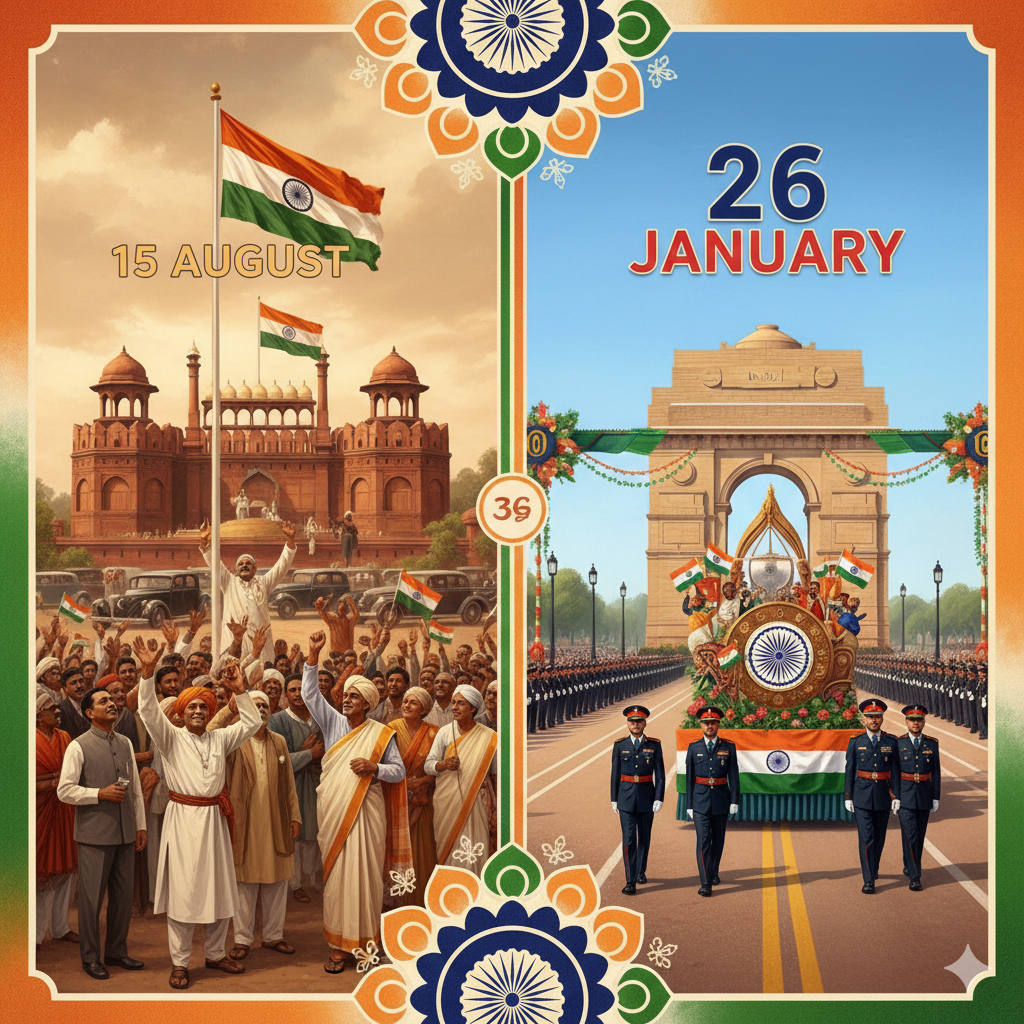
The main celebration takes place in New Delhi at Rajpath, where the President of India hoists the national flag. The grand parade showcases India’s cultural heritage, military prowess, and technological advancements. Unlike Independence Day, which is celebrated at the Red Fort, Republic Day celebrations are marked by a display of national pride through tableaus from different states and performances by school children.
| Aspect | Republic Day (January 26) | Independence Day (August 15) |
|---|---|---|
| What is Celebrated | Enforcement of the Constitution (1950) | Freedom from British rule (1947) |
| Main Event Location | Rajpath, New Delhi | Red Fort, New Delhi |
| Flag Ceremony | President unfurls the flag | Prime Minister hoists the flag |
| Nature of Celebration | Parade showcasing military might and cultural diversity | Flag hoisting and speech by Prime Minister |
| Constitutional Significance | Celebrates India becoming a republic with its own constitution | Marks political independence from colonial rule |
| International Participation | Chief Guest from foreign country invited | Primarily domestic celebration |
Republic Day Flag Unfurling
By: The President of India
Action: The flag is unfurled (already tied up and opened by pulling the ropes)
Significance: The President, as the constitutional head, unfurls the flag to commemorate the Constitution coming into force. Since the country is already independent, the flag is not raised from below but unfurled from the top of the pole.
Ceremony: The National Flag remains tied up at the top of the flagpole and is unfurled without pulling it up.
Independence Day Flag Hoisting
By: The Prime Minister of India
Action: The flag is hoisted (raised from below to the top)
Significance: The Prime Minister, as head of government, hoists the flag to commemorate the birth of a new nation. The act symbolizes India rising from colonial subjugation to sovereign independence.
Ceremony: The National Flag is folded and kept at the bottom of the pole, then raised to the top.
Why the difference? On Independence Day, the flag is hoisted to symbolize the rise of a new nation. On Republic Day, the flag is unfurled to celebrate an already established nation’s adoption of its governing constitution. This subtle distinction carries deep constitutional significance, reflecting India’s journey from independence to becoming a republic.
Unified in Diversity: The Twin Pillars of Indian Democracy
Both Republic Day and Independence Day are integral to India’s national consciousness, representing different milestones in the nation’s journey. Independence Day celebrates freedom from foreign rule, while Republic Day honors the establishment of a sovereign, democratic republic governed by the rule of law.
The distinct flag ceremonies on these two days beautifully symbolize India’s constitutional journey: the hoisting on August 15 represents the nation’s rise to independence, while the unfurling on January 26 represents the flourishing of that independence under a constitution crafted by “We, the People of India.”
Together, these celebrations remind us of the sacrifices made for freedom and the responsibility we carry to uphold the constitutional values of justice, liberty, equality, and fraternity.
Leave a Reply