The Hidden Addictions of Modern Life: Sugar, Carbohydrates, and Salary
Waiting for your salary credit message while finishing a packet of Oreos? You’re not alone. Let’s talk about the three seductive chains we call ‘normal life’.
It’s 3 PM on a Tuesday. Your screen is full of Excel sheets, your brain is shutting down, and your hand—almost like a separate creature—reaches for the third chai of the day. Two sugars. A Parle-G on the side. And behind you, the HR manager just whispered, “next week’s hike letters”. Suddenly your pulse quickens, not from the chai, but from the thought of that monthly credit message: “Salary credited — INR xx,xxx”. That little dopamine rocket is stronger than any pastry.
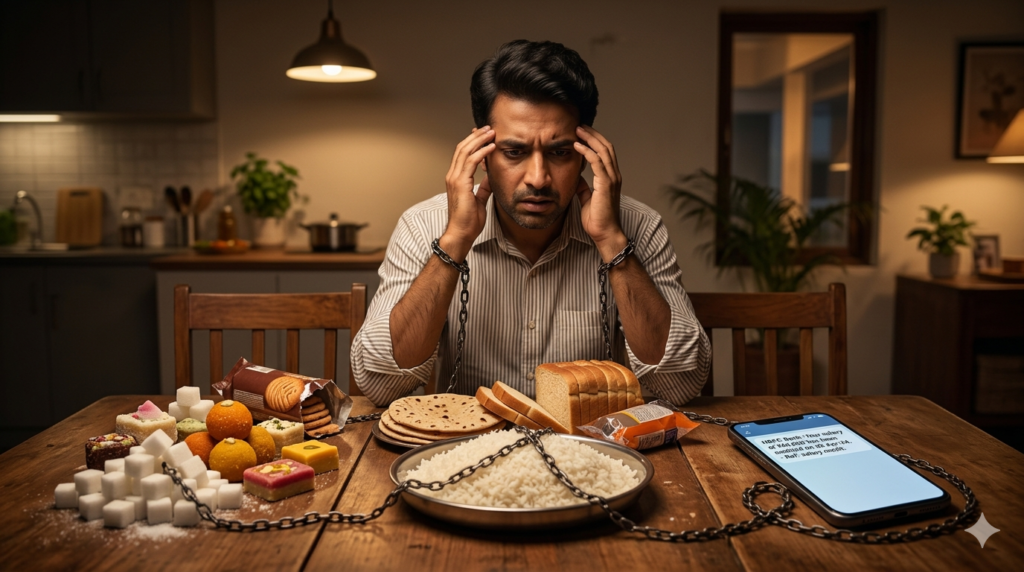
Welcome to the hidden addictions of modern India. Not heroin. Not gambling. Sugar, carbohydrates, and salary. The trifecta that runs our mornings, messes with our moods, and locks us into golden cages. We’ll laugh about it, but by the end, you’ll see your own reflection in a bowl of biryani and a bank statement. Ready? Let’s begin.
🍬 1. Sugar addiction — the sweet poison that owns your cravings
Let’s be real: We don’t eat sugar. We worship it. That little silver foil on a Cadbury Dairy Milk? The first bite of warm jalebi after a stressful meeting? The spoonful of sugar in your filter coffee that turns “okay” into “heaven”? Sugar hijacks your brain’s reward system like a charming thief. Neuroscientists call it “hedonic hunger” — eating for pleasure, not fuel. In India, sugar is woven into hospitality, festivals, and even apologies. “Beta, have some more gulab jamun, you look tired.”
Ever noticed the 5 PM crash? You feel mildly depressed, irritated, and ready to sell your laptop for a packet of Hide & Seek. That’s the sugar rollercoaster: spike, insulin surge, crash, cortisol spike, repeat. In Mumbai offices, Bangalore startups, and Kolkata addas — the pattern is identical. We think we need energy. In reality, we’re feeding an addiction that makes us tired, then demands another hit. And the world doesn’t help. Swiggy Instamart delivers “Dark Fantasy” in 9 minutes. The only fantasy is that we’re in control.
How to spot sugar addiction: the 4 daily symptoms
- Compulsive snacking — finishing a family pack of biscuits while watching reels.
- Inability to stop at ‘one’ — one piece of mithai becomes five because “it’s organic jaggery”.
- Secret eating — finishing leftover cake while standing in front of the fridge at midnight.
- Cravings that vanish after a savory meal? No? Then you’re hooked.
The answer? Not cold turkey (you’ll become insufferable at parties). Rather, start noticing. Next time you reach for sugar, pause 10 seconds. Breathe. Ask: “Am I hungry, bored, or emotionally empty?” Replace one chai with a lemon-ginger tea. Within a week, your energy line flattens — no crashes, no drama. But more on that later.
🍚 2. Carbohydrate dependency — the roti, rice, and rebound hunger trap
In India, a meal without rice or roti is a snack. Ask any middle-class family: “Khaana ho gaya?” means “Did you eat your 3 chapatis and a mountain of rice?” And don’t get me wrong — carbs are not evil. But refined carbohydrates (white rice, maida, polished grains, even excessive “whole wheat” atta) are the cousins of sugar. They metabolize into glucose almost as fast. The result? By 11 AM after a heavy breakfast of poha or upma, you’re looking at the office clock like a prisoner.
Let me introduce you to the phenomenon called “carb coma” — the reason your productivity dips exactly 40 minutes after a thali lunch. Dosa, idli, pav bhaji, biryani… they feel satisfying, but they trigger the same insulin response as dessert. Worse: they mess up leptin (the “I’m full” hormone). So you eat a huge meal, feel sleepy, then crave something sweet within two hours. Vicious cycle. And culturally, we glorify it — “Mummy ne haath se roti banayi” — love and addiction intertwined.
In Indian cities, the “diet culture” swings between keto worship (which is unsustainable) and guilt-ridden binges. The smarter path? Pair carbs with protein and fiber. Have that bowl of rice — but add a generous dal, sabzi, and curd. Swap white rice with brown or millets (ragi, jowar) once a day. And for god’s sake, stop eating chapati-dal-rice together in the same meal if you’re sedentary. Your pancreas is not a fan of that trilogy. The hidden trick: eat protein first. Suddenly your carb craving drops by 50% — because your body was crying for amino acids, not chapatis.
So next Sunday, when you reach for that extra butter naan, laugh and ask: do I want this, or does the addiction want this? It’s liberating to notice without judgment. And then maybe have half a naan. With salad. Small wins.
💸 3. Salary addiction — the paycheck prison & lifestyle inflation
Now for the sneakiest addiction of all — the one your LinkedIn celebrates. Salary addiction is that low-hum anxiety behind every “promotion celebration.” The moment a salary credit hits, you pay EMIs, order Zomato, book a weekend getaway. And by the 25th, you’re holding your breath. Sound familiar? This isn’t about income; it’s about dependency. We become addicted to the certainty of a monthly deposit — so much that we tolerate toxic bosses, meaningless meetings, and burnout. Because the credit message gives us a short-lived dopamine spike. Experts call it “paycheck to paycheck psychology” even when you earn 2 lakhs a month.
Lifestyle inflation: the salary ratchet effect
You get a raise of ₹30,000. Within a month, you upgrade from Maruti to Honda City, rent increases, you join a fancy gym you never use, and the new iPhone appears. By next year, your expenses perfectly match the new salary. No extra savings. That’s hedonic adaptation — the vicious cousin of salary addiction. And in India, with rising social pressure (weddings, Diwali spending, “Log kya kahenge”), it becomes a golden cage.
Think about the sensation you feel when you see “Salary Credited” from HR’s name. A tiny exhale. A moment of relief. Then, within hours, you start calculating bills. Sound like any other craving? The biochemical loop is identical to sugar — expectation → reward → scarcity → repeat. But here’s the twist: salary addiction makes us risk-averse. We don’t switch careers, don’t negotiate better, don’t start side-hustles. Because the paycheck is the pacifier.
Breaking the paycheck trance
Start with “invisible savings” — automate 20% of salary the moment it hits. Create a small “freedom fund”. Try a month of conscious spending: track every rupee like a detective. The real question: Imagine you had 6 months of expenses saved. Would you still tolerate that Monday morning dread? If not, you’re not truly addicted to salary — you’re addicted to the illusion of security. And illusions break with awareness. Also — check internal links: [Insert Internal Link: How to build financial safety net] + [Insert Internal Link: Minimalism for Indian families].
And yes, it’s okay to love your job and want growth. But the moment your bank balance dictates your emotional state, you’ve swapped hunger for spiritual hunger. Let’s fix that.
🔗 The common loop: Why sugar, carbs, and salary are psychological twins
At first glance, sweet cravings and paycheck dependency seem unrelated. But peek beneath the hood: all three are dopamine feedback loops fuelled by modern convenience. Sugar gives a fast high → carbs provide comfort (via serotonin) → salary delivers status and safety (via oxytocin & dopamine mix). But each one creates tolerance. You need more sugar, more refined carbs, a bigger salary to feel the same buzz. Then comes withdrawal: fatigue, irritability, sense of lack.
- Instant gratification culture: Swiggy, Blinkit, UPI, instant loan apps — everything trains us to not delay reward.
- Emotional numbing: Stressed? Eat sweets. Lonely? Order biryani. Anxious about future? Check your PF balance fifty times.
- Social normalization: “Arre chai mein ek spoon sugar aur dal do” or “28% hike? Party to banti hai” — the herd keeps us hooked.
Recognizing the pattern is half the battle. When you see your salary craving as no different from a gulab jamun craving, you detach. You start to watch the urge without obeying it. That’s where freedom begins.
Next month when your salary is credited, don’t check the amount immediately. Wait 30 minutes. Feel the urge to peek. Notice how it’s identical to “one more aloo paratha” impulse. That distance is the space where you choose differently.
🎯 Gentle course correction (without becoming a monk)
We aren’t here to declare war on chai or bonuses. But we can dance with our addictions more consciously. Here are 7 small experiments, India-friendly:
- 2-minute rule for cravings: Craving a samosa? Set a timer for 2 minutes. Drink water. If still craving, eat it with joy — not guilt.
- Protein-first breakfast: Eggs, chilla, paneer, or sprouts. Cuts carb-crash by 70% before lunch.
- Salary detox weekend: One Saturday, don’t check bank apps or spend anything (except essentials). Notice anxiety — it’s just a feeling.
- The “half-sugar” progression: Reduce sugar in tea by 25% for a week. Then another 25%. Your taste buds reset.
- Roti count challenge: Replace 2 rotis with 1 roti + large bowl of sabzi for 5 days. Energy improves dramatically.
- Auto-invest before Zomato: Set up a recurring monthly SIP of even ₹500 on salary day — before any shopping.
- Ask ‘who is feeding?’ Before eating or earning, ask yourself: Am I feeding hunger, loneliness, habit, or fear? No wrong answer — just awareness.
Remember: you don’t need to break all three addictions at once. Start with sugar for two weeks, then watch how carb cravings reduce. As you stabilize blood sugar, your financial impulsiveness also drops. (Yes, glucose spikes worsen impulse buying — science backs this.) Everything is connected.
For deeper reading, explore authoritative resources like Harvard’s Nutrition Source on glycemic load (external reference: www.hsph.harvard.edu/nutritionsource) and behavioral finance insights from Daniel Kahneman. No need to become a saint — just become a curious observer of your own habits.
✨ Epilogue: The sweetest freedom is not needing the next hit
Modern Indian life will keep tempting you. New biryani place. Diwali bonus. “Limited edition” KitKat. The algorithms know your weaknesses because addiction is profitable. But you, my friend, are not an algorithm. You are a magnificent, messy human who can laugh at her own compulsions. The moment you see salary as a tool, not a lifeline; sugar as a guest, not a master; carbs as fuel, not a mother’s hug substitute — you reclaim your agency.
Does this mean you’ll never binge on pav bhaji again? Of course you will. But you’ll do it with wide-open eyes, enjoying every bite without the silent shame. And the next month when salary credits, you’ll smile, sip your half-sugar chai, and feel an unfamiliar sensation: enoughness. That feeling is worth more than any bonus.
So here’s the hidden truth: these three addictions aren’t character flaws. They are adaptations to a chaotic, high-speed, pressure-cooker world. But awareness rewires. Start with one meal, one salary credit, one deep breath. And watch your life become lighter. Not perfect — just yours. Now go drink some water. And maybe check your auto-debit settings. 😉
Written with reflection & spice — no bots were harmed. 🧉
Leave a Reply