Akshay Tritiya: Tradition, Devotion,
and the Gold Buying Truth
Everything you need to know about the auspicious day — and what the jewellery industry doesn’t want you to think about.
✨Introduction: The Day That Never Runs Out
“Every year, millions of Indians line up outside jewellery stores on Akshay Tritiya. The question is — are they buying prosperity, or are they buying into a very well-crafted marketing story?”
Once a year, something extraordinary happens across India. Gold prices inch upward, jewellery stores deck themselves in marigolds, and families across the country — from Delhi to Chennai, from Ahmedabad to Kolkata — flock to make that one special purchase. Akshay Tritiya, often called India’s most auspicious day, is simultaneously a festival of deep spiritual devotion and, let’s be honest, a goldmine (pun absolutely intended) for the jewellery industry.
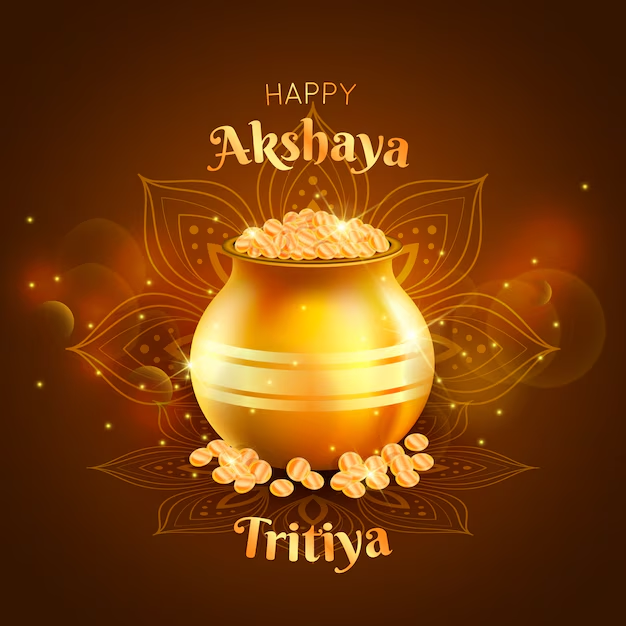
But behind the glitter, there’s a festival of profound meaning. The word “Akshay” comes from Sanskrit, meaning imperishable, eternal, or never-diminishing. And “Tritiya” means the third lunar day. Put them together, and you have a day when — according to Hindu belief — any good deed, prayer, investment, or beginning yields eternal, indestructible returns.
That’s a beautiful idea. But does it hold up financially? Should you actually be buying gold on this day, or is that a tradition that has been turbocharged by savvy marketers? And more importantly — what does Akshay Tritiya actually mean, beyond the shopping?
Let’s explore everything: the mythology, the spirituality, the rituals, and yes — the hard, rational truth about gold buying. Buckle up, because this one is going to be as layered as a good piece of Kanjivaram silk.
📜What Is Akshay Tritiya? Historical & Mythological Background
Akshay Tritiya — also known as Akha Teej in North India — falls on the third day (Tritiya) of the bright fortnight (Shukla Paksha) of the Hindu month of Vaishakh, which typically corresponds to April or May in the Gregorian calendar.
What makes this day astronomically special is that it is one of the rare Swayam Siddha Muhurtas — an auspicious time that does not require a priest or an astrologer to validate it. It is inherently, cosmically auspicious. On this day, the sun and moon are simultaneously in their positions of exaltation, making it extraordinarily powerful in Vedic astrology.
Did you know? Akshay Tritiya is one of only three days in the Hindu calendar considered universally auspicious without the need for any astrological confirmation. The other two are Vijaya Dashami (Dussehra) and Vijayadashami.
Mythological Origins
The mythological roots of Akshay Tritiya run deep into the Puranas, the Mahabharata, and the Srimad Bhagavatam. Several pivotal celestial and historical events are said to have occurred on this very day:
- Birth of Lord Parashurama: The sixth avatar of Lord Vishnu — the warrior sage who rid the earth of corrupt Kshatriyas twenty-one times — is believed to have been born on Akshay Tritiya. This is why the day is also known as Parashurama Jayanti.
- Beginning of the Treta Yuga: Hindu cosmology divides time into four great ages (Yugas). Akshay Tritiya is considered the day on which the Treta Yuga — the age of Lord Rama — commenced, making it a cosmic turning point.
- Descent of Ganga: According to the Puranas, the sacred river Ganga descended from the heavens to earth on this day, purifying the mortal world.
- Mahabharata dictation begins: The sage Vedavyasa began dictating the great epic Mahabharata to Lord Ganesha on Akshay Tritiya, marking the start of an eternal literary monument.
- The Akshay Patra: Lord Krishna gifted the Pandavas — during their exile — a magical vessel called the Akshay Patra, which would never run dry of food, ensuring Draupadi could feed an unlimited number of guests. This happened on Akshay Tritiya, cementing the day’s association with abundance and inexhaustibility.
- Lord Kubera’s Golden Age: The god of wealth, Kubera, is said to have received his divine wealth and status on this auspicious day, reinforcing its association with gold and prosperity.
Each of these events ties the day to themes of abundance, new beginnings, divine grace, and eternal merit — making Akshay Tritiya a day that carries extraordinary spiritual weight in Hindu culture.
🕉️Religious & Cultural Significance of Akshay Tritiya
The importance of Akshay Tritiya extends far beyond a single religious tradition. While it is fundamentally a Hindu festival, it holds significance across Jainism as well, making it one of India’s truly cross-faith celebrations.
In Hinduism
In Hindu tradition, Akshay Tritiya is above all a day of devotion to Lord Vishnu, the preserver of the universe. Vishnu temples across India witness massive footfall, with devotees performing special prayers, abhishekam (ritual bathing of the deity), and offering tulsi leaves — believed to be especially dear to the Lord.
Prayers to Goddess Lakshmi — the deity of wealth and fortune — are also central to the day’s observances. Families invoke her blessings for prosperity and well-being, offering lotus flowers, red cloth, and sweets.
The deity Kubera — the treasurer of the gods — also features prominently. Worshipping Kubera on Akshay Tritiya is believed to bring enduring financial prosperity. Many business owners perform special Kubera Puja or Lakshmi-Kubera Puja on this day to bless their enterprises.
Critically, Akshay Tritiya is considered the ideal day to begin new ventures: launching a business, signing property deals, starting construction of a new home, conducting marriages, or beginning any major life project. The belief is that a beginning made on this day carries an eternal blessing — that the endeavour will never be diminished.
In Jainism
For the Jain community, Akshay Tritiya carries its own powerful significance. It is called Akha Teej and commemorates the day when Rishabhdeva (also known as Adinath), the first Tirthankara of Jainism, broke his year-long fast by accepting sugarcane juice from a king. This moment of sacred charity inaugurated the Jain tradition of dana (charitable giving), and the day is observed with great reverence through fasting and the giving of alms.
“Akshay Tritiya is not merely a shopping holiday dressed in religious clothing. It is one of the most spiritually loaded days in the Hindu calendar — a day when the very fabric of cosmic time is believed to be aligned with auspiciousness.” — Vedic Tradition & Scholarship
⭐Why Is Akshay Tritiya Considered So Auspicious?
The auspiciousness of Akshay Tritiya is not arbitrary. It arises from a confluence of several spiritual and astronomical factors, each of which amplifies the others.
- Swayam Siddha Muhurta: As mentioned, this day requires no additional auspicious timing. Every moment of the day is inherently good — a rarity in the Hindu calendar where most auspicious actions require careful astrological planning.
- Planetary Exaltation: According to Vedic astrology, the sun is in the sign of Aries (exalted) and the moon is in the sign of Taurus (exalted) on Akshay Tritiya, creating what astrologers call a supreme alignment of solar and lunar energies.
- Beginning of Eternal Merit: Any act of devotion — be it prayer, charity (daan), fasting, or pilgrimage — performed on this day is believed to generate akshay punya, or imperishable merit that accompanies the soul across lifetimes.
- Sattvic Energy: Spiritually, the day is considered to be saturated with sattvic (pure, harmonious) energy, making it ideal for meditation, new beginnings, and sacred rituals.
- Cosmic Alignment of Multiple Events: The fact that so many mythologically significant events are associated with a single date — from Parashurama’s birth to Ganga’s descent — is itself seen as a reflection of the day’s cosmic importance.
All these factors combine to make Akshay Tritiya arguably the most powerful single day in the Hindu year for spiritual practice, new beginnings, and acts of charitable giving.
🪷Traditions and Rituals Observed on Akshay Tritiya
The rituals of Akshay Tritiya vary beautifully across India’s different regions, yet share a common thread of devotion, charity, and celebration. Here’s a look at what people typically observe:
Morning Rituals
- Snan (Sacred Bath): Devotees wake before sunrise and bathe in holy rivers — or, failing that, add a few drops of Gangajal to their bath water — to purify themselves before the day’s worship.
- Puja at Home: Families set up a puja thali with flowers, incense, lamps, and fruits. Prayers are offered to Lord Vishnu, Goddess Lakshmi, and Kubera. Tulsi leaves, conch shells, and yellow or golden-coloured flowers are especially auspicious.
- Vishnu Sahasranama: Recitation of the thousand names of Lord Vishnu is considered particularly meritorious on this day.
Acts of Charity (Daan)
If there is one tradition that all spiritual authorities agree upon, it is this: charitable giving on Akshay Tritiya yields infinite returns. The act of daan is considered the highest form of observance on this day. This includes:
- Offering food and water to the poor — particularly cooling foods like sattu, raw mangoes, and clay pots of water, appropriate for the summer season
- Donating clothing, footwear, and umbrellas
- Feeding Brahmins and seeking their blessings
- Contributing to temples, schools, and charitable organisations
- Feeding animals, birds, and cows
Regional Variations
- Rajasthan & Gujarat: Akha Teej is celebrated as a major festival. It is one of the most popular days for weddings, even child marriages (a practice now illegal and being actively discouraged). Grand fairs and community celebrations are held.
- West Bengal: Farmers begin the agricultural season on this day, ploughing their fields in a ceremony called Hal Khata, believing the harvest will be blessed.
- Odisha: The famous Rath Yatra preparations for the Jagannath Temple begin on Akshay Tritiya, with the chariots for the great procession starting construction.
- South India: Temples see elaborate abhishekam (ritual baths) for the presiding deities. Many families prepare special sweet offerings like Panakam (jaggery-pepper drink) and distribute them.
🥇The Gold Buying Tradition: Where Did It Come From?
Here’s where things get interesting — and a little complicated. The association between Akshay Tritiya and gold buying is real, but its roots are more nuanced than the jewellery industry would like you to believe.
The Spiritual Connection
Gold has been revered in Indian culture for millennia, not merely as a financial asset, but as a sacred metal associated with divinity and auspiciousness. In Hindu tradition, gold represents the energy of the sun, is associated with Goddess Lakshmi, and is seen as a symbol of purity and eternal value — much like the “akshay” quality of the day itself.
Historically, gold was also a practical store of wealth in pre-banking India. Buying gold was one of the primary ways families preserved wealth across generations. Doing so on an auspicious day like Akshay Tritiya made both spiritual and practical sense — you were protecting your family’s future while earning divine blessings for doing so.
The tradition also draws from the idea of Kubera Puja — worshipping the god of wealth — and offering gold as part of that ritual. Over time, buying gold became synonymous with the worship itself.
The Modern Transformation
For most of India’s history, the gold-buying on Akshay Tritiya was a modest, family-oriented tradition — perhaps buying a small ornament or coin as a token of prosperity and devotion. The amounts were not extravagant; the sentiment was.
The dramatic escalation of gold purchasing on this day into a national buying frenzy is, frankly, a much more recent phenomenon. India’s liberalisation in the 1990s, the explosion of organised retail jewellery chains, and aggressive marketing campaigns transformed a quiet tradition into one of the biggest gold-buying events on the planet.
The Scale Today: India now sells an estimated 40–50 tonnes of gold on Akshay Tritiya alone — roughly 20–25% of India’s average monthly gold consumption, compressed into a single day. This is not organic tradition; this is industrial-scale marketing dressed in religious sentiment.
📊Is Buying Gold on Akshay Tritiya Really a Good Financial Decision?
Let’s be genuinely honest here, because this is where the spiritual and the rational must have a frank conversation.
The Price Problem: You’re Buying at the Peak
One of the most straightforward financial problems with buying gold on Akshay Tritiya is timing. Demand drives prices, and the extraordinary spike in gold demand in the weeks before and on Akshay Tritiya causes gold prices to be notably elevated. You are, quite literally, buying at one of the most expensive moments of the year.
If you observe gold price trends over multiple years, you’ll consistently see a pre-Akshay Tritiya rally followed by a post-festival softening. The crowds rushing to buy gold on this day are, ironically, creating the very price peak they’re buying at. This is the opposite of good investment practice, which suggests buying low and selling high.
The Hidden Costs of Physical Gold
When you buy physical gold jewellery — which is what most people do on Akshay Tritiya — you’re not just paying for the gold. You’re paying for:
- Making charges: Typically 8–25% of the gold’s value, sometimes more for intricate designs. These charges are non-recoverable when you sell.
- GST: 3% GST on gold purchase in India, plus 5% GST on making charges.
- Wastage charges: Some jewellers levy additional wastage charges of 5–15%.
- Storage and security costs: Physical gold needs to be stored safely, which means either bank locker fees or the constant anxiety of keeping it at home.
- Resale discount: When you sell physical gold, you’ll typically get a price below the current market rate, and making charges are never recovered.
Quick Math: If you buy jewellery worth ₹1,00,000 on Akshay Tritiya, you might actually be paying for only ₹65,000–₹75,000 worth of actual gold, with the rest going to making charges, taxes, and wastage. For gold to simply break even, its price needs to rise by 25–35% first.
Gold as an Asset Class: The Honest Assessment
To be fair to gold — it is not a bad asset. Over the very long run (20–30 years), gold has delivered reasonable returns in India, largely because the rupee has depreciated significantly against the dollar, and gold is priced in dollars globally. Gold also serves as a powerful hedge against inflation and currency devaluation, and it has historically been an excellent safe-haven asset during geopolitical crises.
But — and this is crucial — these benefits apply to gold as an investment, not necessarily to physical jewellery bought at a demand-driven price peak. There’s a significant difference between the two.
| Factor | Physical Gold (Jewellery) | Gold ETF / Digital Gold / SGB |
|---|---|---|
| Price paid | Gold price + 15–30% extra costs | Near-spot gold price |
| Returns on resale | Making charges lost; discounted rate | Full gold price appreciation captured |
| Interest income | None | 2.5% p.a. (SGBs only) |
| Storage risk | High — theft, loss possible | None — dematerialised |
| Emotional value | High — wearable, gift-able | Low — numbers on a screen |
| Tax efficiency | Capital gains apply; no additional benefit | SGBs: Tax-free at maturity |
Emotional Investing vs Rational Investing
Here is the uncomfortable truth that behavioural economists call the “auspicious day effect”: our emotional state on a day perceived as lucky or special significantly lowers our critical thinking about financial decisions. We are wired to associate the feeling of an auspicious day with the likelihood of a good outcome — even when the numbers tell a different story.
Add to that the social pressure of “everyone else is buying gold today,” and you have a perfect storm of emotionally-driven financial decision-making. It takes genuine self-awareness to separate the spiritual observance from the financial impulse.
🎯Marketing Gimmick or Genuine Belief? A Critical Look
Let’s be balanced: the tradition is real and ancient. The marketing exploitation of that tradition is also real and modern. These two things can coexist, and recognising both is not disrespectful to the festival — it’s intellectually honest.
How the Jewellery Industry Supercharged the Tradition
Beginning in the late 1990s and accelerating through the 2000s and 2010s, India’s organised jewellery retailers — Tanishq, Kalyan Jewellers, Malabar Gold, and dozens of regional chains — identified Akshay Tritiya as a massive commercial opportunity. What followed was one of India’s most sustained and successful long-term marketing campaigns:
- Massive advertising spending in the weeks before Akshay Tritiya, linking gold buying explicitly with auspiciousness and prosperity
- EMI schemes, no-making-charges offers, lucky draws, and exchange bonuses to lower the barrier to purchase
- Bollywood celebrity endorsements in festival-themed ad films
- Special “Akshay Tritiya Collections” launched specifically for the season
- In-store experience upgrades — traditional decor, free sweets, extended hours
The result? A cultural tradition that was once modest became a massive consumer event. Today, Akshay Tritiya is the single biggest day for gold sales in India, generating thousands of crores in revenue. The industry has, brilliantly and commercially, tied religious sentiment to consumer behaviour in a way that is very difficult for the average buyer to untangle.
The Behavioural Psychology of the Buyer
Why do we fall for it? Several powerful psychological mechanisms are at work:
- Scarcity framing: “This auspicious day comes only once a year!” — creates urgency.
- Social proof: When millions are buying, it feels foolish not to.
- Loss aversion: The fear of missing out on divine blessings — or a good sale — drives purchases.
- Confirmation bias: Stories of people who “invested in gold on Akshay Tritiya and prospered” are shared widely; stories of those who didn’t particularly benefit are not.
- Framing effects: Buying gold is framed as an “investment” and a “tradition,” both of which feel virtuous — not as a retail purchase, which can be scrutinised.
“The most powerful marketing is the kind you don’t recognise as marketing — because it wears the costume of culture, faith, and tradition.” — Behavioral Economics Perspective
None of this means that buying gold on Akshay Tritiya is wrong. If it brings you joy, if it connects you to your heritage, if it’s a conscious choice you can afford — do it with full awareness and no guilt. The problem arises only when the marketing pressure pushes people into financially strained decisions in the name of auspiciousness.
💡Smarter Alternatives to Physical Gold on Akshay Tritiya
If you want to honour the spirit of Akshay Tritiya — the idea of making an investment in your future that yields eternal returns — here are financially smarter alternatives to buying physical gold jewellery:
1. Sovereign Gold Bonds (SGBs)
Issued by the Reserve Bank of India, SGBs are arguably the best gold investment vehicle for Indian investors. You get:
- Exposure to the full price appreciation of gold
- 2.5% annual interest paid semi-annually — physical gold earns nothing
- Complete capital gains tax exemption if held to maturity (8 years)
- No storage risk, no making charges, no purity concerns
- Government-backed — as safe as it gets
If you want gold in your portfolio on Akshay Tritiya, SGBs are the most intelligent form to buy it in. Check the RBI website for current issuance windows.
2. Gold ETFs (Exchange Traded Funds)
Gold ETFs are listed on stock exchanges and track the price of physical gold in real time. Key advantages:
- No making charges or purity risk
- Can be bought and sold like stocks during market hours
- Very small investment amounts possible — even ₹500 worth
- Highly liquid
3. Digital Gold
Platforms like Paytm, Google Pay, PhonePe, and Zerodha Coin offer digital gold backed by physical gold stored in secure vaults. You can buy as little as ₹1 worth. It’s convenient, accessible, and a much purer form of gold exposure than jewellery.
4. Equity Mutual Funds via SIP
For truly long-term wealth creation, equity mutual funds via Systematic Investment Plans (SIPs) have historically outperformed gold over 10–20 year horizons in India. Starting or increasing your SIP on Akshay Tritiya — with the intention of creating lasting wealth — is perfectly in keeping with the festival’s spirit of eternal prosperity.
5. Investment in Education & Skills
Here’s an unconventional thought: what investment yields the most akshay (never-diminishing) returns? Your own education and skill development. A course, a certification, a book — these compound over decades in ways that even gold cannot match.
The Spirit of Akshay Tritiya, Financially Applied: The deepest meaning of “akshay” is not about buying a metal — it’s about making beginnings that create enduring value. An SIP in equities started on Akshay Tritiya, a Sovereign Gold Bond purchased, or a skill learned carries the same eternal spirit that the day celebrates.
🌟What Should You Actually Do on Akshay Tritiya?
Here’s a practical, meaningful, and financially grounded guide to making the most of Akshay Tritiya — balancing tradition with wisdom:
Spiritually
- Wake early, bathe, and observe a brief period of meditation or prayer
- Visit a Vishnu temple or Lakshmi temple; participate in the puja
- Recite the Vishnu Sahasranama or any devotional text meaningful to you
- Practice genuine gratitude — count your blessings; it’s more powerful than you think
In the Spirit of Daan (Charitable Giving)
- Donate meaningfully to a cause you believe in — food, education, healthcare
- Feed those around you — the act of feeding someone on Akshay Tritiya is considered deeply meritorious
- Volunteer your time or skills to a community organisation
- Plant a tree — truly “akshay” in its returns to the earth
Financially
- If you want gold, buy digital gold, a Gold ETF, or check for an SGB window
- Start a new SIP in a well-researched mutual fund
- Review and update your financial plan for the year
- Open or top up your PPF account
- Buy gold jewellery only if you genuinely love it as jewellery — not as an investment — and budget for it consciously
For New Beginnings
- Register that business you’ve been meaning to start
- Sign up for that course you’ve been procrastinating on
- Have a conversation you’ve been avoiding — with a parent, a partner, a colleague
- Write down your goals for the next year; the act of beginning matters
The most akshay thing you can do on Akshay Tritiya is make a beginning that you actually follow through on. The day’s power comes from the intention and the effort — not from a gold biscuit in a locker.
🪔 Conclusion: The Gold Is Inside the Tradition
Akshay Tritiya is genuinely one of the most auspicious and spiritually rich days in the Hindu calendar. Its roots in mythology, cosmology, and centuries of devotional practice are real and worthy of reverence. The themes it celebrates — eternal abundance, gratitude, new beginnings, and generous giving — are among the most universal and enduring human aspirations.
The gold-buying tradition has its own historical logic. Gold as a symbol of Lakshmi’s grace, as a family heirloom, as a cultural connector — all of this is legitimate and meaningful. If buying a small piece of gold jewellery on Akshay Tritiya is a conscious family tradition that brings you joy and doesn’t strain your finances — honour it fully.
What is worth questioning is the magnitude and urgency manufactured by commercial interests, the conflation of heavy jewellery purchases with divine blessing, and the financial consequences of emotionally-driven gold buying at demand-peak prices.
The truest spirit of Akshay Tritiya asks you not to accumulate, but to begin. Not to buy, but to give. Not to hoard, but to invest — in relationships, in knowledge, in the future, and yes, perhaps also in gold, but wisely.
The day is auspicious whether you buy gold or not. What makes it truly akshay — truly inexhaustible — is the quality of the intentions you bring to it.
Shubh Akshay Tritiya. 🪔
❓Frequently Asked Questions About Akshay Tritiya
Leave a Reply