The Magic of Music in the 90s: From Audio Cassettes to YouTube – What We Lost Along the Way
A love letter to pencils jammed into cassette reels, ₹10 notes saved for weeks, and the indescribable joy of finally hearing a song you had been waiting for.
Close your eyes for a moment. Try to remember a Saturday afternoon somewhere in the mid-1990s. The ceiling fan is turning lazily above your head. There is a faint smell of rice cooking in the kitchen. Your mother is humming something from the radio in the next room. And you — you are sitting cross-legged on the floor, staring at a small rectangle of plastic and magnetic tape in your hand, turning it over like it contains the secrets of the universe.
Because for us — the generation that grew up during the golden age of music in the 90s India — it really did.
That cassette, that thin, fragile, sometimes frustratingly tangled cassette, was not just a music format. It was an event. It was a ritual. It was, in a way, a relationship. And now, in 2026, as we scroll through Spotify playlists or hit shuffle on YouTube with barely a thought, something tugs quietly at the heart. A small, stubborn voice that says: yaar, it was so different back then. So much more… alive.
When a New Film Release Was a National Event
In the 1990s, a new Bollywood film did not just arrive — it descended. Weeks before the release, the city would begin buzzing. Hand-painted hoardings would go up on street corners. The local cable TV would start playing the trailer on loop. And before you even heard a single note of the music, you already felt it — that crackling electricity of anticipation in the air.
But the thing about woh din is that the music of a film would come out before the film itself. The cassette would release first. And that was its own kind of magic.
You would see it in the shop window — a fresh new cassette with the film’s name printed in bold colours on a crisp inlay card. Maybe it was Dilwale Dulhania Le Jayenge. Maybe it was Hum Aapke Hain Koun. Maybe it was Kuch Kuch Hota Hai. Whatever it was, you already knew you had to have it. The question was never whether you wanted it. The question was always: how do I get the money?
That cassette in the window was not just music. It was a destination. And the journey to get there — saving, waiting, longing — made the music feel like it was truly yours.
The Sacred Economy of ₹5, ₹10, and ₹20 Notes
If you grew up middle-class in India in the 90s, pocket money was not a right. It was a privilege. You got it on good behaviour, on birthdays, during festivals, or sometimes — if you were lucky — when a visiting relative felt generous after pinching your cheeks hard enough to leave marks.
A brand new audio cassette cost anywhere between ₹25 and ₹60, depending on the film and the label. For a ten-year-old getting ₹5 a week, that was an eternity of saving. You would fold those small notes with absurd care, tuck them inside the back of your geometry box, and pray no emergency interrupted your plan.
Sometimes you pooled money with your best friend. Sometimes you convinced your older cousin to buy it and let you borrow it for the weekend. Sometimes you stood outside the cassette shop and just read the song titles on the display cassette behind the glass, memorising them, whispering them to yourself like a prayer.
The point is: the music was earned. Every rupee saved was also a unit of longing. And that longing — that beautiful, almost painful anticipation — made the eventual moment of pressing play feel like nothing short of a miracle.
The Cassette Shop — A Temple of Sound
Every mohalla had one. That one small shop — barely the size of a large bathroom — with cassettes stacked floor to ceiling, sometimes behind glass, sometimes hanging on cardboard hooks, sometimes just piled in dusty towers that only the shopkeeper could navigate. There was always a large tape recorder or speaker playing something. The shopkeeper always had strong opinions about music.
Walking into that shop was a sensory experience unlike anything else. The faint smell of the plastic cases. The visual riot of colourful cassette covers. Songs from five different cassettes bleeding into each other near the entrance. And the shopkeeper — usually a middle-aged man with a bored expression that transformed the moment you asked about his favourite album.
You would point at something. He would pull it out, let you read the inlay card. You would stand there, reading each song title, the name of the music director, the lyricist, the playback singer. Slowly. Carefully. Like you were reading a treasure map. Because you were.
This was the audio cassette memories generation’s version of discovering an artist. Not a Wikipedia page. Not a Spotify bio. A small folded piece of paper inside a plastic case, printed in fonts that were sometimes barely legible, full of information you absorbed like water into dry earth.
We did not stream music. We studied it. We read every name on that inlay card. We knew who wrote the words and who sang them and who made the music come alive. That knowing felt like belonging.
The Rituals: Rewinding, Walkman Days, and Playing Songs on Loop
The Pencil Trick and the Patience It Taught Us
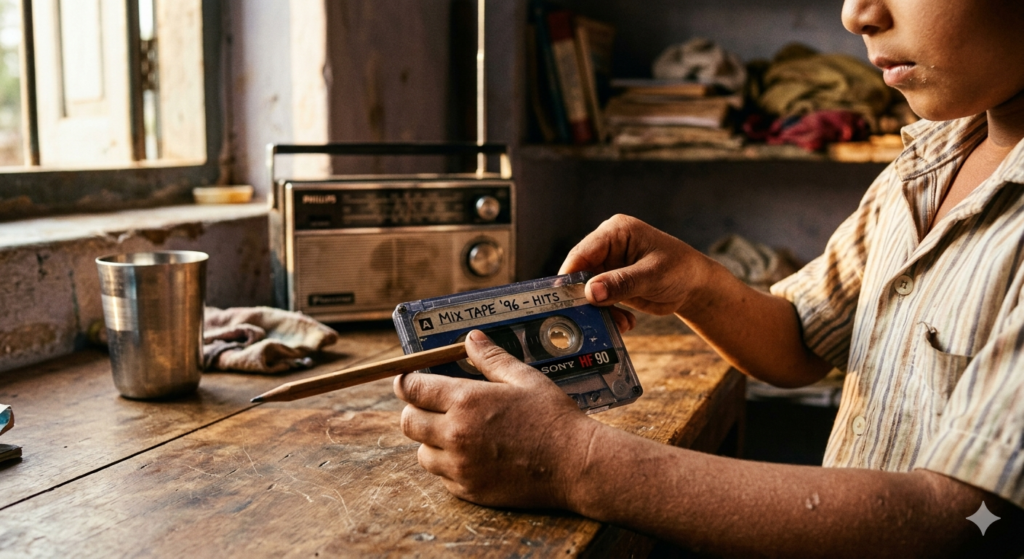
If you are a true child of the 90s, your hands already know what to do when someone says cassette ulatna. You flip it over, find side B. But before that, there was the legendary act of rewinding. You pressed rewind and waited. The tape whirred. Sometimes it spooled back fast. Sometimes it got stuck and the tape would unspool into a ribbon of chaos that made your heart sink.
That is when you reached for a pencil. You jammed it into the wheel of the cassette and turned it manually, coaxing the tape back into its shell, winding carefully, slowly, with the kind of gentle patience that life before internet music required. It was meditative. It was sometimes maddening. It was also, in its own strange way, a form of love.
Because you only did that for something you truly wanted to hear again.
The Walkman: A World in Your Ears
If someone in the family owned a Walkman, they were the cool one. Full stop. That little device — heavy, prone to eating batteries, with foam headphones that pressed painfully against your ears — was the closest thing the 90s Indian middle class had to magic. You could walk down the street and be completely inside a song. In your own world. Invisible to everything else.
Most of us shared a single family tape recorder though. The big one in the hall, sometimes decorated with stickers, with a removable speaker on one side. You would put in your cassette, adjust the volume dial with military precision, and announce to the household that this was your listening time. Then you would sit close to it, almost leaning in, as though the music needed your full physical presence to complete itself.
Playing a song on loop meant pressing stop, rewinding manually, and pressing play again. Over and over. For a song you were obsessed with, you might do this twenty, thirty times in a single afternoon. And the song never got boring. It grew. Each listen peeled back another layer. You heard things you had not heard before. A harmony in the background. A pause before the chorus. The way a particular note landed.
This was life before internet music, and in its apparent limitation was an extraordinary depth of engagement.
The Early 2000s: Upgrade Time, But at a Cost
The cassette era faded slowly, the way all golden ages do. Not with a bang, but with a quiet replacement. One day, the shops started stocking CDs alongside cassettes. Then the cassettes moved to the back shelf. Then they disappeared.
The compact disc was a genuinely exciting thing. Crystal clear sound. No rewinding. No tangled tape. You could skip tracks with a button. You could see the number of songs right there on the display. It felt like the future, and in many ways it was.
Then came the CD writer. Then the MP3 CD. Then the idea that you could fit 150 songs on a single disc — something that would have seemed like science fiction to your 1995 self. You could burn a mixtape. You could create your own collection. You could get music from a friend’s computer, copy it, carry it.
The barriers were lowering. The effort was reducing. And the music was multiplying.
It was exciting. Of course it was exciting. But somewhere in that excitement, something quietly left the room.
When music became easier to get, it also became easier to forget. The songs you burned onto a CD you never listened to all the way through. The albums you downloaded but never really heard. The playlists that scrolled off the screen before the song even ended.
2026: The Age of Everything, Instantly
Today, in 2026, every song ever recorded is approximately three seconds away from your ears. You do not need money. You do not need a shop. You do not need a pencil or a tape recorder or a patient afternoon. You need a phone and a data connection, and the entirety of human musical output is available to you before your next heartbeat.
YouTube. Spotify. Apple Music. JioSaavn. Gaana. The options are overwhelming. The algorithms are generous. The recommendations are eerily accurate. And the music — objectively speaking — sounds better than it ever did through those foam Walkman headphones or that family tape recorder in the hall.
So why does something feel missing?
This is the central heartbreak of the cassette to YouTube journey, and it is one that anyone who lived through both eras will recognise immediately. The music did not get worse. Our relationship with it did.
What Convenience Quietly Stole From Us
The first thing we lost was scarcity. When you could only afford one cassette a month, that cassette became your whole world. You listened to it until you knew every breath the singer took, every change in the rhythm, every word that the lyricist had chosen. You did not skip songs. You did not shuffle. You listened in order, from beginning to end, because that is how the music director intended it to be heard — as a journey, not a grab bag.
The second thing we lost was anticipation. Woh intezaar — that waiting, that longing — was not a bug in the system. It was the system. It was the thing that made the music mean something before you even heard it. When you finally pressed play on a cassette you had saved for three weeks to buy, you were not just listening to songs. You were completing a quest. And that feeling coloured everything you heard.
The third thing we lost was shared experience. Music in the 90s India was communal in a way that streaming will never replicate. When a film’s cassette released, everybody was listening to the same songs at the same time. Your classmates, your neighbours, the autowallah, the shop next door — all tuned to the same frequency. You could hum a song and a stranger across the street would hum back the next line. That is not nostalgia talking. That was genuinely the texture of daily life.
And the fourth thing — perhaps the most important — was emotional ownership. You did not just hear those songs from the 90s. You inhabited them. You associated them with specific moments, specific feelings, specific people. Because you could not escape the music — you had only one cassette, after all — the music could not escape you either. It embedded itself in your memory like a stain. A beautiful, permanent, beloved stain.
Today we have access to everything. Back then, we had access to very little. And yet somehow, those few songs felt like more.
The Philosophy of the Pencil and the Reel
There is a larger truth hiding inside all of this 90s nostalgia India, and it goes beyond music. It is about what it means to truly value something.
We live in an age of radical abundance. More content, more music, more everything than any previous generation could have imagined. And yet — paradoxically — many of us feel less satisfied, less connected, less moved by what we consume. We finish a song before it finishes us. We move to the next one before the first one has settled.
The cassette generation did not have that option. The tape had a side A and a side B, and that was your universe for the evening. You made peace with it. You went deep. You found things in songs that people who heard them once on shuffle will never find.
That pencil you used to rewind the tape — it was not just a tool. It was a gesture of commitment. It said: I am willing to do the work to hear this again. I am willing to slow down. I am willing to be patient. I value this enough to earn it, even in this small way.
In the age of instant streaming, we never have to make that gesture. And we are poorer for it, even as we are richer in every measurable way.
Convenience increased. Catalogue exploded. Quality improved. But somewhere between Side A and the algorithm, the magic got left behind.
A Note of Hope — and a Question
This is not a manifesto against technology. Streaming music is genuinely wonderful. The fact that a teenager in a small town in India can discover jazz or Carnatic classical or lo-fi hip-hop without needing to know anyone who stocks it — that is extraordinary. That is democratisation at its most beautiful.
But there is something worth carrying forward from those audio cassette memories. Something worth protecting, even in the age of infinite playlists.
The practice of sitting with a single album. Of listening from track one to the last track without skipping. Of letting a song repeat until it has given you everything it has. Of paying attention — real, full, unhurried attention — to the music that moves you.
Because the songs themselves have not changed. Lata Mangeshkar’s voice is still devastating in all the ways it always was. Gulzar’s words still land like small, precise stones dropped into still water. A.R. Rahman can still make you feel something in your chest that you cannot name but recognise immediately.
The songs are still there, waiting. The question is whether we are willing to show up for them the way we used to — with patience, with attention, with the kind of love that is not diminished by having too many other options.
So here is the question I leave you with, yaar:
When was the last time you listened to a song — just one song — from beginning to end, doing nothing else, letting it take you somewhere completely? When was the last time music felt like it cost you something, and was worth every bit of that cost?
Maybe it is time to rewind.
Not to the past — you cannot go back there, and honestly, the mosquitoes were bad and the summers were brutal and the internet not existing was mostly not great. But rewind to the feeling. The intention. The willingness to be fully present with a song the way a twelve-year-old was fully present with a new cassette on a slow Saturday afternoon in 1997.
Woh din are gone. But the feeling — that is still available. It just requires a choice that the algorithm will never make for you.
📼
Side B — The songs that never left us.
Disclaimer: cle is a personal, nostalgic reflection on growing up with music in India during the 1990s and early 2000s. All song references, brand names, and cultural details are mentioned in a general editorial context for the purposes of storytelling and nostalgia only. No commercial affiliation is implied. The WhatsApp share link above should be updated with your actual article URL before publishing.
Do you remember your first cassette? The first song that made your heart skip?
Tell us in the comments below — let’s rewind together. 📼