April 2, 2011: Dhoni’s Six, Sachin’s Dream, and the Night India Made History
The 2011 ICC Cricket World Cup Final — Revisited, Remembered, Revered
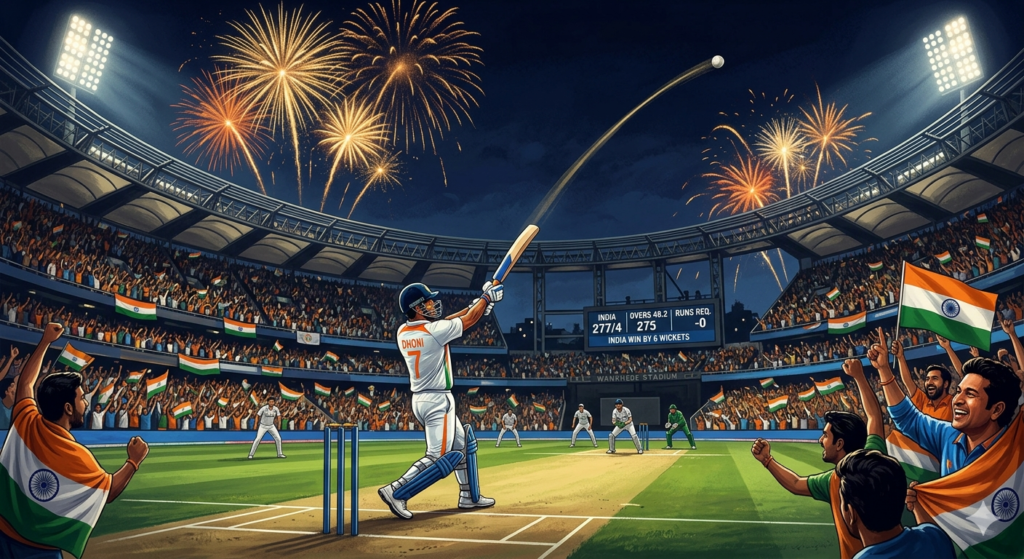
There are moments in sport that transcend the scoreboard. Moments that stop time. Moments so overwhelming that an entire nation — more than a billion people — exhales simultaneously in disbelief, joy, and tears. April 2, 2011 was one such night. At the Wankhede Stadium in Mumbai, under a cascade of stadium lights, MS Dhoni stepped back, planted his right foot, and heaved Nuwan Kulasekara over long-on. The ball sailed into the Indian night sky in a slow, majestic arc. It cleared the rope. And India won the 2011 ICC Cricket World Cup.
That six did not just win a cricket match. It ended a 28-year wait. It carried the weight of a generation’s longing. And for one man in particular — Sachin Ramesh Tendulkar — it fulfilled a dream he had chased his entire career.
The Stage: Mumbai’s Wankhede, April 2, 2011
The ICC Cricket World Cup 2011 final between India and Sri Lanka was played at the iconic Wankhede Stadium in Mumbai on April 2, 2011. This was not just any final. India was playing at home — emotionally, geographically, and spiritually. The host nation had navigated through the group stages and knockouts with an almost divine sense of purpose, culminating in a tournament that gripped the country like nothing before.
Sri Lanka, captained by the elegant Kumar Sangakkara, won the toss and chose to bat. The Lankan top order fired beautifully. Mahela Jayawardene played what many consider one of the finest World Cup Final innings ever — a masterful 103* off 88 balls, laced with silken timing and composed authority. Sri Lanka posted a formidable total of 274 for 6 in 50 overs.
📊 Final Scorecard — Wankhede Stadium, Mumbai
| Team | Score | Overs | Key Performer |
|---|---|---|---|
| 🇱🇰 Sri Lanka | 274 / 6 | 50 | Jayawardene 103* (88) |
| 🇮🇳 India | 277 / 4 | 48.2 | Dhoni 91* (79), Gambhir 97 |
| India won by 6 wickets — MS Dhoni, Player of the Match | |||
India’s Chase: Heartbreak, Hope, and Heroism
India’s run chase began with quiet dread. The Lankan pacers were sharp, the pitch unpredictable. Virender Sehwag — the man everyone expected to tear the attack apart — was dismissed for a duck by Lasith Malinga in just the second over. The Wankhede went silent. Then came another thunderclap: Sachin Tendulkar, India’s greatest batsman, playing his sixth and almost certainly final World Cup, was removed for just 18 runs. Two wickets down for 31, the dream looked fragile.
But then, Gautam Gambhir — one of the most underrated match-winners in Indian cricket history — refused to panic. His innings of 97 runs off 122 balls was a study in calculated aggression and ice-cold nerves. He stitched a vital partnership with Virat Kohli (35), slowly but surely turning the tide.
When Kohli departed, MS Dhoni walked in at Number 5, having controversially elevated himself above the in-form Yuvraj Singh. The stadium buzzed. Dhoni, never one to show emotion, settled quietly. He surveyed the field. He watched. And then, over the next 79 balls, he played what would be remembered as the most important innings of his career.
The Dhoni Masterclass: Calm in the Storm
Dhoni’s innings of 91 not out off 79 balls was not the flashiest he ever played. But it was the most important. What made it extraordinary was not the shot-making alone — it was the timing of each calculated risk. He read the match situation with the precision of a chess grandmaster, keeping pace with the required run rate, never letting pressure overwhelm him.
His partnership with Gambhir brought India back into the game. As the overs dwindled, the required run rate inched up but never ran away. With India needing 4 runs to win off the remaining overs, Dhoni — on 84 at the time — faced Nuwan Kulasekara in the 48th over.
Gambhir Falls for 97
Gambhir is dismissed three runs short of a World Cup final century, getting caught behind. India need 4 more runs to win. Wankhede holds its breath.
The Six Heard Around the World
MS Dhoni pulls away, plants his back foot, and launches Kulasekara over long-on. The ball clears the boundary. India win by 6 wickets. Pandemonium erupts.
Sachin is Carried on Shoulders
Players carry Sachin Tendulkar on a lap of honour around the Wankhede. A moment that needs no commentary. India had carried Sachin’s dream for 21 years — now, they carried him.
That Six: Ball-by-Ball, Frame by Frame
Kulasekara ran in. Full ball, angled in. Dhoni stepped outside his crease, transferred his weight to his back foot, and swung with full power through the line. The bat face was open, the swing was immense. The ball erupted off the willow and rose high into the Mumbai sky. Every eye in Wankhede — and across 135 million television sets in India — tracked that flight path.
It cleared the long-on boundary with ease. The umpire’s signal — arms raised in the air — was instantly swallowed by the roar of a million decibels. Dhoni raised his bat. He jumped — a rare display of raw emotion from the most stoic man in Indian cricket. The players rushed the field. Fireworks erupted. A nation wept, laughed, danced, and screamed all at once.
Sachin’s Dream: The Weight of 21 Years
No story of the 2011 World Cup Final is complete without Sachin Tendulkar. He had played in five previous World Cups. He had scored more runs than any player in the history of the tournament. He had carried India on his back for over two decades. And yet, the World Cup had always eluded him — the one trophy that could have completed the most celebrated career in cricket history.
When India won that night, the players instinctively sought out Sachin. They hoisted him onto their shoulders and paraded him around the Wankhede — the very ground where he had played his club cricket as a child, the ground where his journey began. It was a moment of profound, wordless beauty. The image of Sachin, draped in the tricolour, being carried on the shoulders of his teammates — tears streaming down his face — became one of the most iconic photographs in the history of Indian sport.
Why April 2, 2011 Still Matters to Every Indian
India’s 2011 World Cup win was not merely a sporting achievement. It was a cultural earthquake. It united a country of 1.3 billion people across every line — language, religion, state, and class — in a single, shared moment of ecstasy. In cities and villages alike, strangers hugged on the streets. Firecrackers burst across every skyline from Kashmir to Kanyakumari. The nation did not sleep that night.
- India ended a 28-year wait for a World Cup title, having last won in 1983 under Kapil Dev.
- It was the first World Cup final played on home soil that India won.
- Dhoni became only the second captain after Clive Lloyd and Kapil Dev to win the ODI World Cup.
- The win cemented Dhoni’s legacy as India’s greatest ever white-ball captain and finisher.
- It validated years of Sachin Tendulkar’s dedication and gave his career its most beautiful final chapter.
The Unsung Heroes of the 2011 Final
While Dhoni’s six rightfully dominates memory, the 2011 World Cup win was a collective triumph. Several players deserve their share of immortality:
Gautam Gambhir — The Forgotten Hero
His 97 off 122 balls in the final was arguably the most important innings of the match. Batting through India’s collapse at the top, Gambhir held the innings together with a calm and determination that often goes unappreciated in the shadow of Dhoni’s spectacular finish. He deserved a century and deserved more credit.
Zaheer Khan — The Spearhead
Throughout the tournament, Zaheer Khan led India’s bowling attack with intelligence and pace. His ability to take wickets with the new ball and at the death was crucial to India’s campaign, even if the final’s narrative belongs to the batsmen.
Yuvraj Singh — Player of the Tournament
Yuvraj Singh was extraordinary throughout the 2011 World Cup, scoring 362 runs and taking 15 wickets — earning him the Player of the Tournament award. What made his performance all the more remarkable was that he was fighting a serious illness, later revealed to be cancer, during the tournament itself.
Lessons Cricket and Life Can Draw From That Night
- Calmness under pressure is a superpower: Dhoni’s ice-cool demeanour in the chase remains the definitive blueprint for performing under pressure.
- Trust the process, not just the outcome: India did not play a perfect game — they lost early wickets. But they trusted each other and stayed in the moment.
- Unsung contributions matter: Gambhir’s 97 was as vital as Dhoni’s 91*. In sport and in life, the visible glory often rests on invisible foundations.
- Teamwork transcends individual brilliance: The 2011 squad was not built around one player. It was a collective — batsmen, bowlers, fielders, and a captain who brought it all together.
- Dreams deferred are not dreams denied: Sachin waited 21 years. The dream came. It always does, if you keep showing up.
Further Reading & Official References
- ICC Cricket World Cup Official Website — Full Tournament History
- BCCI Official Website — Board of Control for Cricket in India
- ESPN Cricinfo — Full Scorecard: India vs Sri Lanka, World Cup Final 2011
- Olympics.com — MS Dhoni’s Legendary World Cup Final Six
- Encyclopaedia Britannica — History of the Cricket World Cup
What Happened in the 2011 ICC World Cup Final?
The 2011 ICC Cricket World Cup Final was played on April 2, 2011, at Wankhede Stadium, Mumbai. Sri Lanka batted first and posted 274/6, with Mahela Jayawardene scoring 103*. India, in their chase, lost Sehwag and Tendulkar early but were rescued by Gautam Gambhir (97) and MS Dhoni (91*). Dhoni promoted himself up the order and finished the match in dramatic fashion with a massive six over long-on off Nuwan Kulasekara, giving India a 6-wicket victory with 10 balls to spare, ending India’s 28-year wait for a World Cup title.
- Date: April 2, 2011
- Venue: Wankhede Stadium, Mumbai
- Result: India beat Sri Lanka by 6 wickets
- India’s score: 277/4 in 48.2 overs
- Sri Lanka’s score: 274/6 in 50 overs
- Player of the Match: MS Dhoni (91*)
- Player of the Tournament: Yuvraj Singh
- Winning shot: A six by MS Dhoni off Kulasekara in the 48th over
Frequently Asked Questions (FAQs)
A Night That Belongs to Every Indian Forever
Fifteen years have passed since that extraordinary April night in Mumbai. Dhoni has retired. Sachin has long hung up his boots. Yuvraj, Gambhir, Zaheer — an entire generation has taken its bow. But the memory of that six does not age. It does not fade. It is frozen in amber, perfect and eternal.
Every Indian who was alive on April 2, 2011, remembers exactly where they were when Dhoni hit that six. That is the mark of a truly transcendent moment — when sport becomes memory, and memory becomes identity. India did not just win a cricket match that night. India became, in the truest sense of the word, World Champions.
And somewhere in that memory — carried on the shoulders of a team, beneath the floodlights of Wankhede, with firecrackers raining down from a grateful nation — Sachin Tendulkar smiled, and 1.3 billion hearts smiled with him.
Leave a Reply